
Travel story 9 min read
MyTravelBuddy Stories
Sunday Decides the Hà Giang Loop
The Hà Giang Loop's two best weekly markets — Mèo Vạc and Đồng Văn — both trade on Sunday morning, twenty-two kilometres apart, and both are over by half past ten. So the real decision is not which market you want; it i…
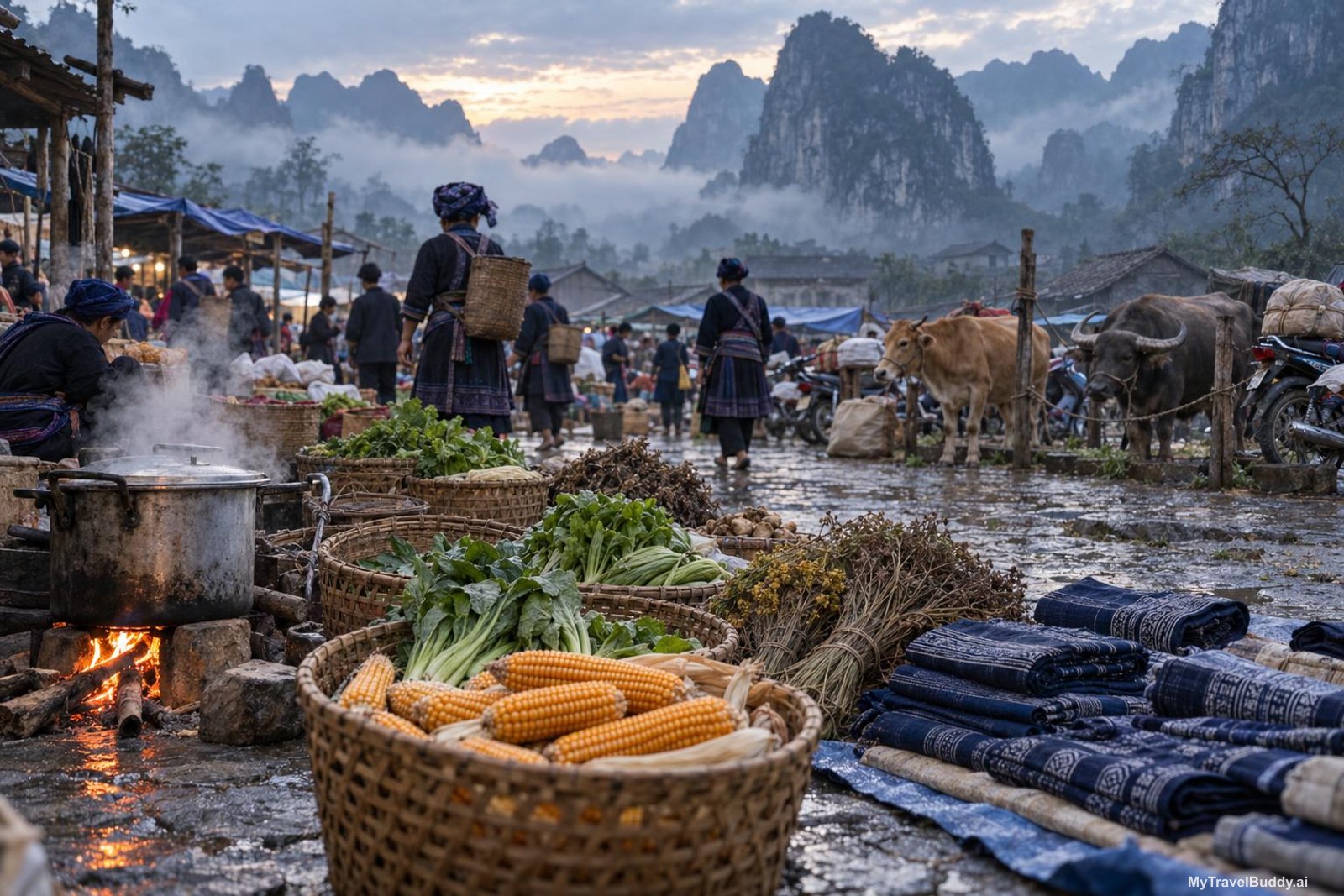
There is a particular hour on the Đồng Văn karst plateau that does not repeat. It starts around half past five on a Sunday morning, in the dark, with engines. Motorbikes come down off the mountain roads two and three to a seat, loaded with sacks and chickens and a grandmother holding the whole arrangement together. Baskets land on wet stone. Somebody lights a fire under a pot that has been blackened by a thousand previous Sundays. By six, the market ground in Mèo Vạc is full, and the air smells of woodsmoke, maize, wet buffalo and corn wine, in roughly that order.
Here is the problem with that hour: it happens at exactly the same time twenty-two kilometres away, in Đồng Văn, and most people ride the Hà Giang Loop without ever realising they had to choose.
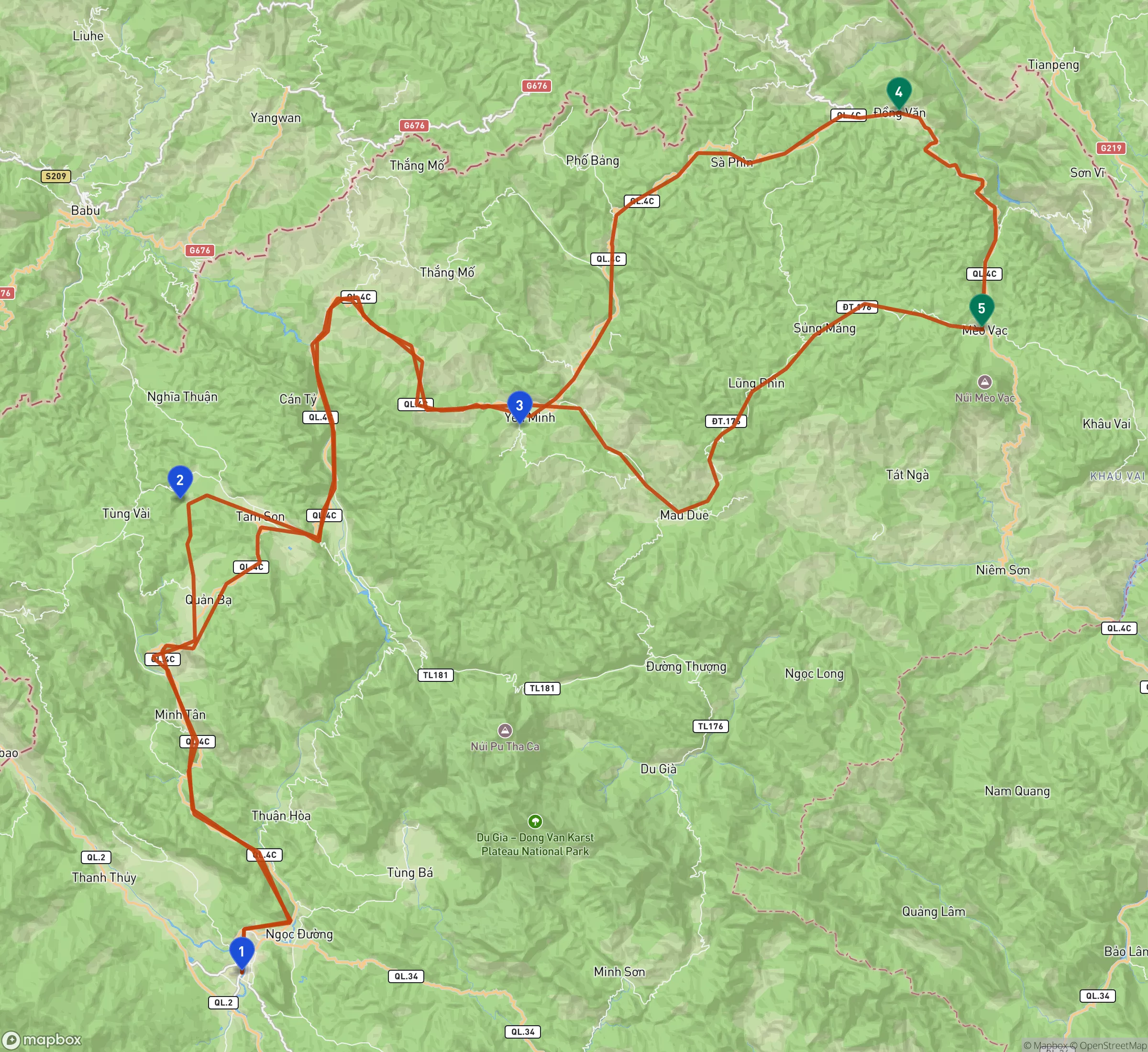
The loop as Google Routes drives it: Hà Giang (1) to Quản Bạ (2) to Yên Minh (3) to Đồng Văn (4) to Mèo Vạc (5) and back, about 319 kilometres in total. The two green markers are the Sunday markets — and you can only wake up next to one of them.
Two great markets, one morning
The loop's two best weekly markets both trade on Sunday morning. Mèo Vạc (5) starts earliest, somewhere around 5:30, and is the louder and rawer of the two: the livestock ground behind the main hall is where yellow mountain cattle and buffalo change hands over handshakes and small glasses of rượu ngô, and the thắng cố pots are going before most of us have found our shoes. Đồng Văn (4) opens closer to six, inside and around a stone-and-timber market hall in the old quarter that has been doing this job since the 1920s. It is the gentler one — textiles, Shan Tuyết tea, medicinal roots, bowls of phở and bánh cuốn, coffee stalls where you can sit and watch families arrive.
Both are finished sooner than you think. Trading thins from about ten, and by half past, people are starting the long walk home. A market that peaks at 6:30am and ends at 10:30am is not something you drift into after a slow breakfast. It is a thing you have to be sleeping next to.
Which means the decision is not really which market — it is which town you sleep in on Saturday night, and that is decided by the day you start the loop.
So start on the right day
Most people ride this as three days and two nights, anticlockwise from Hà Giang: up through Quản Bạ and Yên Minh to Đồng Văn, over Mã Pí Lèng to Mèo Vạc, then the long run back. Google Routes gives the legs as roughly 48 km to Quản Bạ (about 1h20), 56 km on to Yên Minh (about 1h40), 46 km up to Đồng Văn (about 1h20), 22 km over the pass to Mèo Vạc (about 40 minutes), and 147 km home (about four hours). Call the whole thing 319 kilometres. On these roads, with the stops you will actually make, add a third to every one of those numbers.
Lay that against a calendar and it resolves cleanly:
- Start Friday → you are in Mèo Vạc on Saturday night → you wake up inside the cattle market.
- Start Saturday → you are in Đồng Văn on Saturday night → you wake up inside the old quarter market.
That is the entire trick. Nobody tells you, because the loop is usually sold as a route rather than a calendar.
If you want my honest preference: start Friday and take Mèo Vạc. Đồng Văn's old quarter is lovely and you will be walking it on a weekday evening anyway, when the stone hall is quiet and the coffee is better. Mèo Vạc's livestock ground has no weekday equivalent. It is not staged for anyone, it is slightly overwhelming, and it is the single most alive hour on the plateau.
One exception, and it is a real one this month: if Sunday is wet, flip the recommendation. Đồng Văn's market has a roof over much of it. Mèo Vạc's cattle ground does not.
If you genuinely want both
You can. It is tight but it is not a fantasy, because the distance is small and the road is the good one.
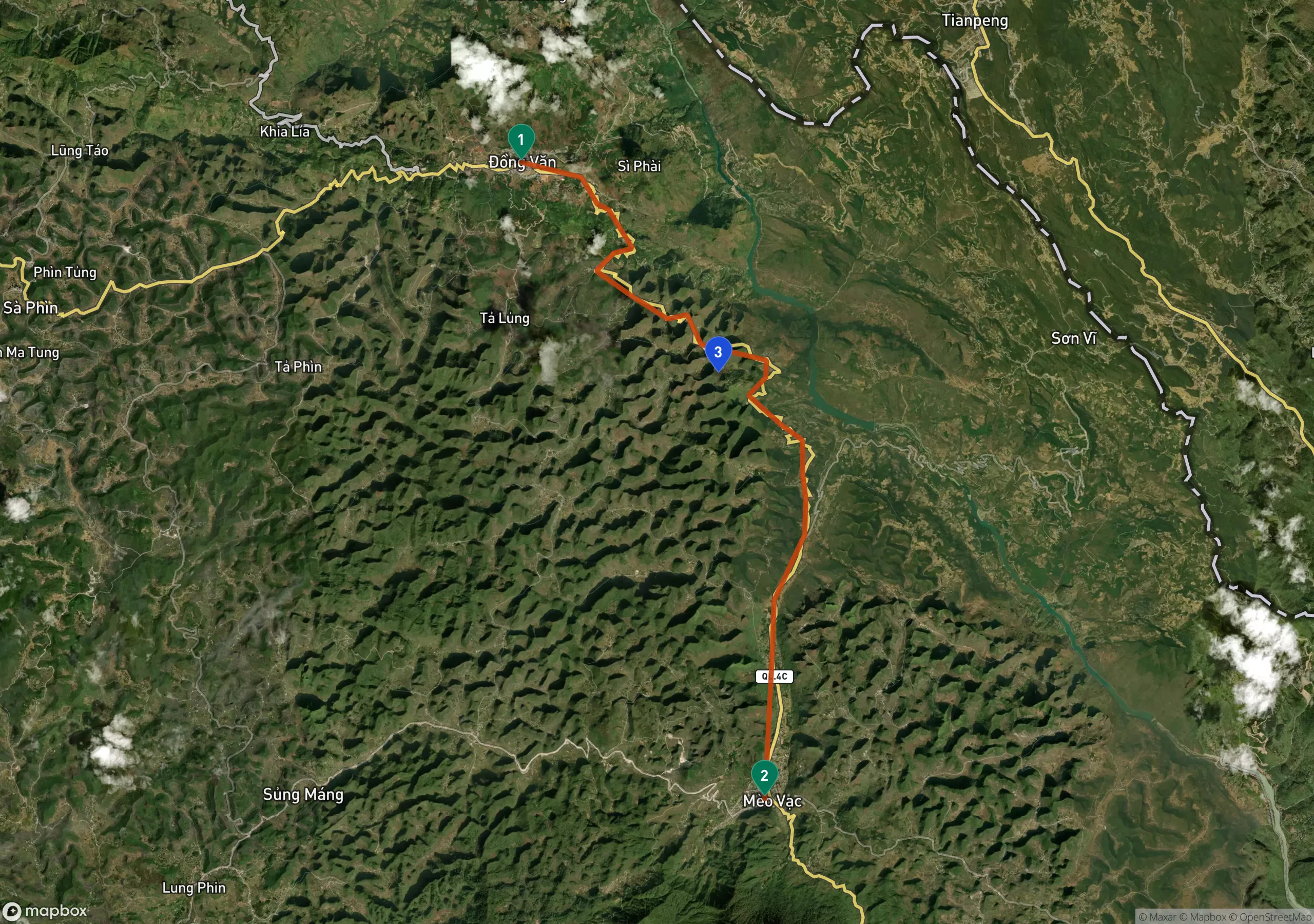
Twenty-two kilometres and forty-one minutes on paper: Mèo Vạc (2) to Đồng Văn (1) over Mã Pí Lèng (3). Leave the cattle market by half past eight and you can still catch Đồng Văn packing up.
Be at Mèo Vạc (2) by 5:45 while the livestock trading is at full volume, eat something, leave by about half past eight, and ride the twenty-two kilometres north over Mã Pí Lèng (3). Google puts that at forty-one minutes. Give it ninety. You will stop at the pass — everybody stops at the pass, and the drop to the Nho Quế river below is the reason the road exists in the traveller's imagination. You will arrive in Đồng Văn (1) somewhere around ten, in time for the tail end: the packing up, the last bowls, the knot of friends who stay longest.
You will have rushed two things instead of properly inhabiting one. I would still do it once.
The markets that move
The Sunday pair are the fixed ones. Scattered around them are the chợ lùi — "backward markets" — village gatherings that slide one day earlier every week. Sunday this week, Saturday next, Friday the week after. Four worth catching if your dates happen to land: Lũng Phìn, held on the lunar days of the Tiger and the Monkey, and about as uncommercial as these things get; Phó Cáo, on the Dragon and Dog days, stone-walled and good for buckwheat cakes; Sà Phìn, on Snake and Pig days, right across from the Vương family palace; and Má Lé, near the border on Rat and Horse days, where the herb and hand-forged tool stalls are the draw.
Do not try to compute these from a lunar calendar app and build an itinerary on it. The honest advice is to ask your homestay or operator the night before — they know, and the answer costs you one question. For what it is worth, published schedules even disagree about the day of the Yên Minh (3) market, which tells you something about how much weight to put on any website, including this one, versus the person pouring your tea.
What mid-October actually looks like up there
The fortnight ahead reads mild and damp rather than dramatic. Open-Meteo has Đồng Văn in the low-to-mid twenties by day and around 18°C before dawn, with drizzle more days than not: the wettest days in the current forecast are Friday 16 October at about 4 mm and Friday 23 October at about 7 mm, while both Sundays look workable — around half a millimetre on 18 October and a dry, overcast 25 October near 21°C. Forecasts this far out move, so treat that as a shape rather than a promise. The shape is: you will be riding in low cloud some mornings, and the viewpoints will sometimes be a wall of white.
Dress for that. Dawn at the market is genuinely cold on a motorbike even when the afternoon is 25°C, and the mist does not burn off the plateau as fast as it does in the valleys.
The buckwheat — tam giác mạch, the flower the province is quietly famous for — is only just starting. Mid-to-late October gives you the first fields in white and pale pink, planted in phases and still thin. The deep pink everyone photographs lands in early November, which is also when the Buckwheat Flower Festival and the domestic-tourism crowds arrive. Coming now is a trade: fewer flowers, far fewer people, and cheaper beds.
Two pieces of paperwork, and a name change
First, the border permit. Much of what you came for — Lũng Cú, the plateau roads, Mã Pí Lèng, the descent to the Nho Quế — sits inside the controlled border zone, and the permit is being checked properly in 2026. Operators handle it off a passport scan when you book; independently, you apply in person at 415 Trần Phú in Hà Giang ward with your passport and visa, at least one working day before you ride. Current quotes sit around 260,000₫ per person, though bundling and pricing vary by operator. A Hà Giang permit does not cover Cao Bằng's border communes, so if Bản Giốc is also on the plan, you need both.
Second, the name. In 2025 Hà Giang province was merged into Tuyên Quang, and the paperwork has caught up faster than the guidebooks. Search for the Mèo Vạc market now and the address comes back as 17 Đường Hạnh Phúc, Mèo Vạc, Tuyên Quang — same street, same stone, new province on the label. The loop is still the Hà Giang Loop in every conversation you will have up there. Just do not panic when your map app, your permit and your homestay booking all use a word you have never seen in a blog post.
How to be a decent guest at 6am
These markets are not performances. People have walked three or four hours in the dark to sell a basket of greens, and the week's cash depends on the next four hours.
- Ask before you photograph. A smile and a raised camera gets you a yes or a no, and both answers are fine.
- Buy from the people you photograph. A 30,000₫ bowl of phở is a reasonable price for being welcome.
- Carry small notes — 10,000₫, 20,000₫, 50,000₫. No cards, no QR codes, and nobody can break a 500,000₫ note at seven in the morning.
- Leave the livestock alone. Buffalo kick, horses bite, and the owners are busy.
- Accept the first glass of corn wine. Think carefully about the fourth.
The plateau rewards people who plan around other people's rhythms instead of their own. Get the Sunday right and everything else on the loop — the pass, the gorge, the thin new buckwheat, the second coffee in a stone courtyard — arranges itself around it. This is the kind of trip where a travel buddy that holds your start date, your permit, the Sunday you are aiming at and tomorrow's drizzle in one place quietly earns its keep, so that the only thing you have to remember at 5:30am is to bring cash and get out of the way of the buffalo.
Continue wandering
One more story for the road
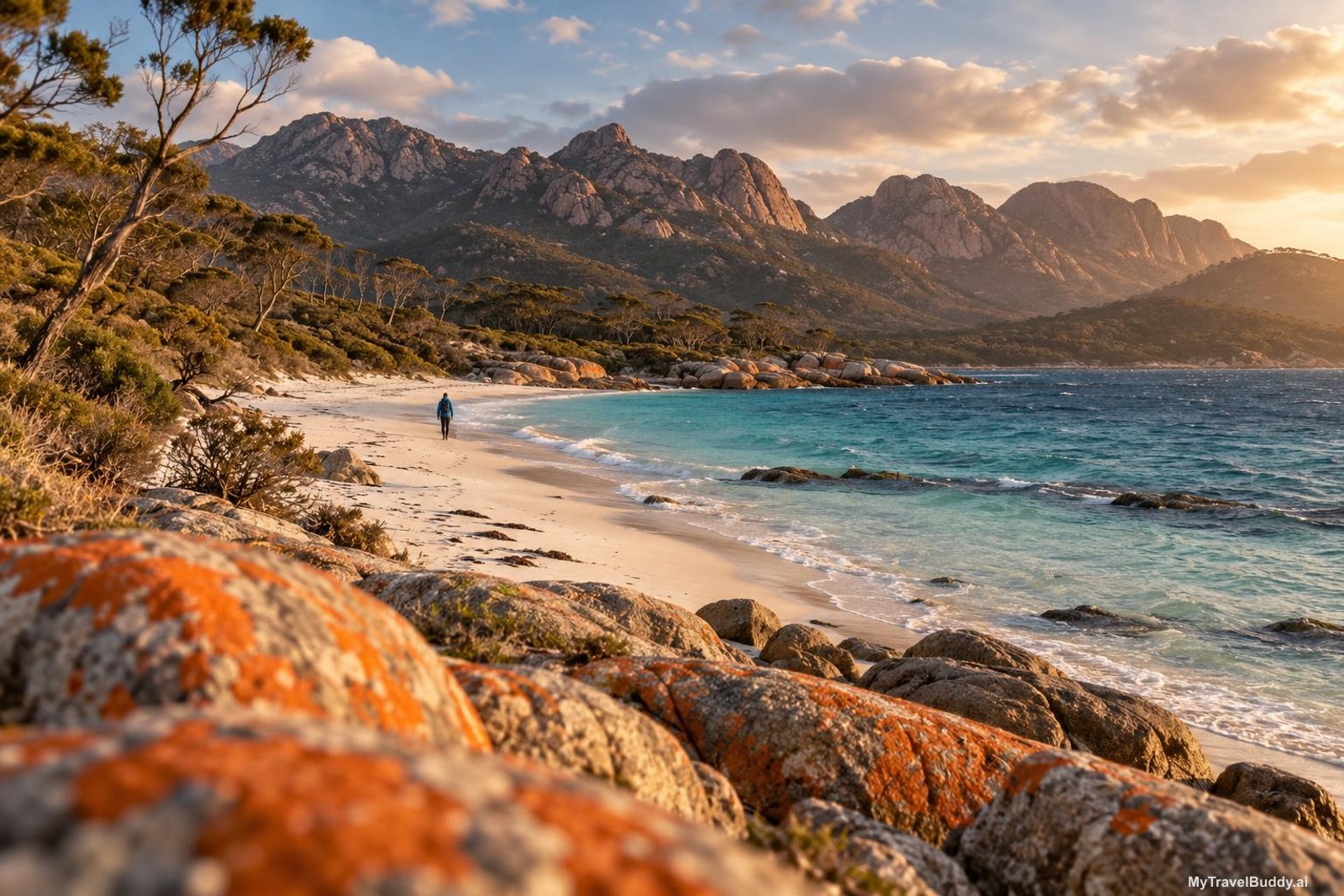
October 12, 2026 · Maya Roam
Hobart to the Bay of Fires, With a Day on Maria Island
Tasmania's east coast is an easy drive and a hard trip to plan well. Hobart to Binalong Bay is 318 kilometres and about four and a quarter hours behind the wheel, spread over four days — but the day that decides the tri…
Read nextInspired to go?