
Travel story 8 min read
MyTravelBuddy Stories
Skip the Boat and Walk Hermanus's Cliff Path
In Hermanus the southern right whales come to the edge of town, and the town built a free footpath along the whole edge. The sections that matter, why wind decides the day more than the date, and where to stand when Gearing's Point gets busy.
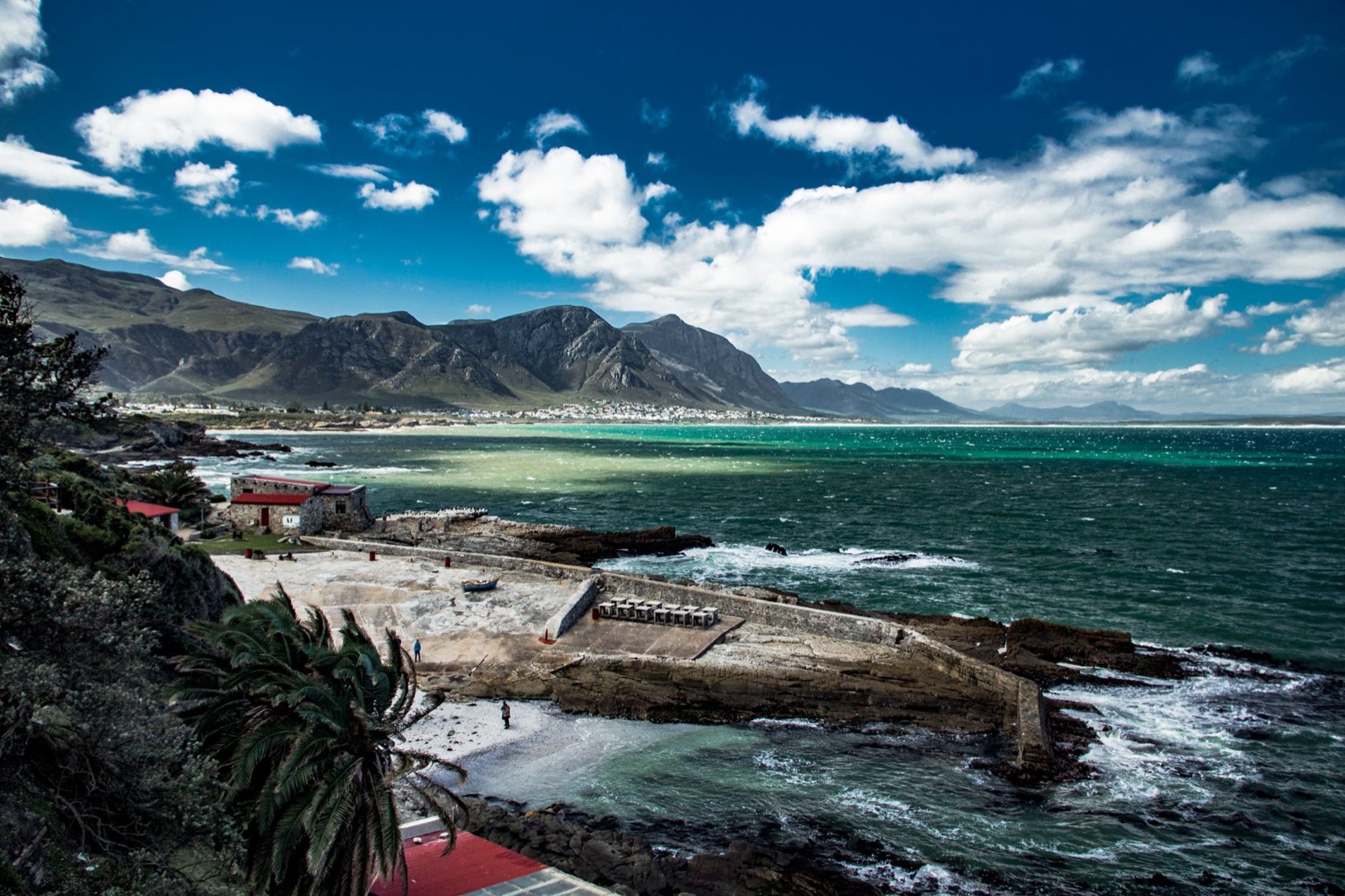
Walker Bay from above the Old Harbour. Photo: Niklas Eichler / Pexels.
There is a low stone wall on Marine Drive in Hermanus, above the Old Harbour, where people stop mid-sentence. Not because of the view, though the view is enormous — Walker Bay opening east in a long green curve, the Kleinrivier mountains stacked behind the town. They stop because somewhere out in front of them, close enough that you hear it before you see it, something the size of a bus has just exhaled.
Southern right whales come into this bay every winter and spring to calve, and they come in close. Not boat-trip close. Wall close. Thirty metres off the rocks, sometimes less, a mother lying on her side with a calf rolling against her, and you standing above her with a takeaway coffee going cold in your hand.
Boats do leave from the New Harbour, and they are a legitimate way to spend a morning. But in Hermanus the boat is the optional part. The whales are already at the edge of town, and the town built a footpath along the whole edge.
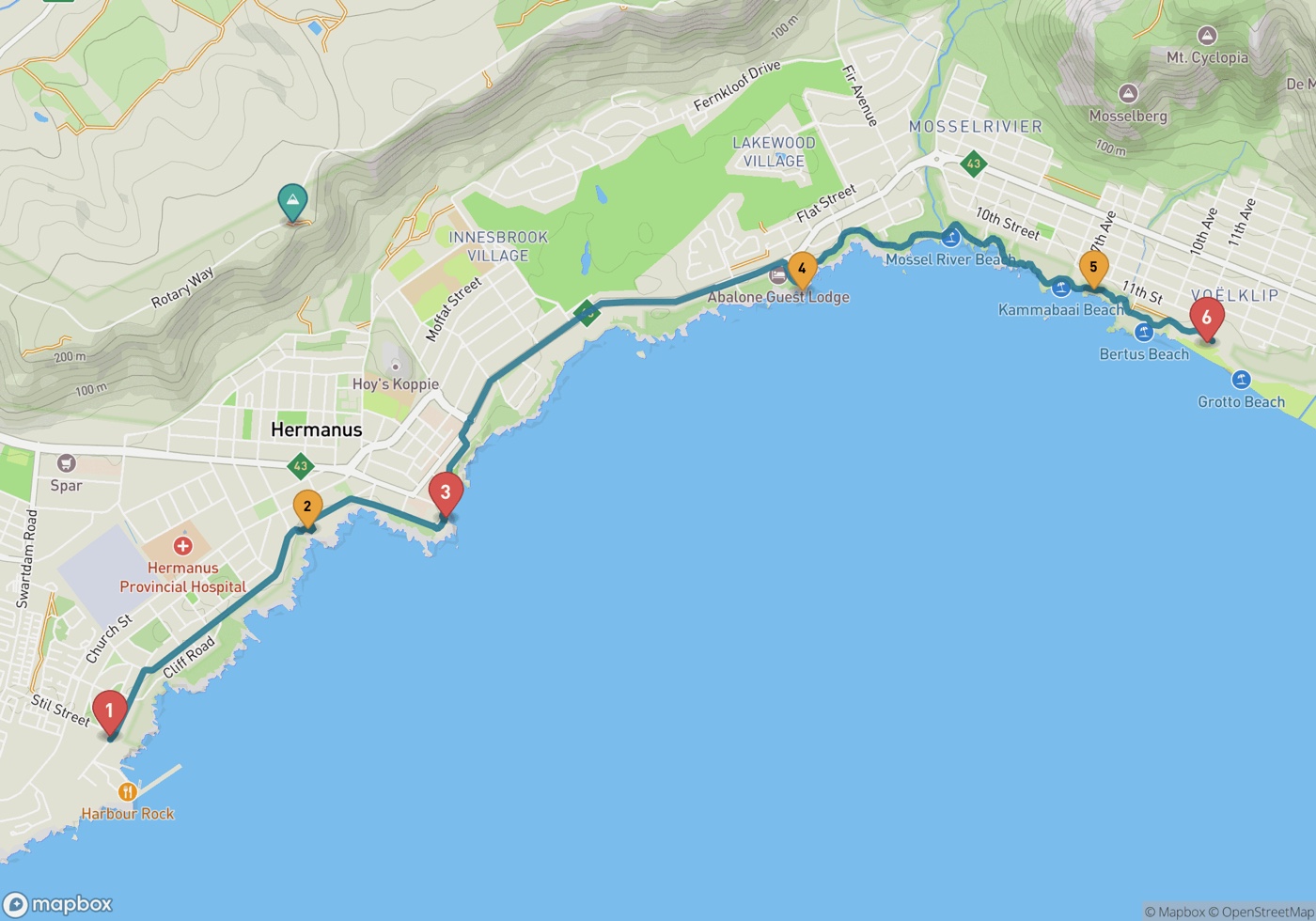
1 New Harbour, 2 Fick's Pool, 3 Gearing's Point and the Old Harbour, 4 Sievers Point, 5 Voëlklip, 6 Grotto Beach. The green pin above town is the Rotary Way lookout.
The path is the attraction
The Cliff Path runs from the New Harbour in the west to Grotto Beach in the east, and it is free, unticketed, and open whenever you are awake. It is not one surface. West of town it is a narrow dirt trail through fynbos with the sea directly below you; through the centre it widens into paved promenade with benches and railings; east of Sievers Point it turns into a mix of boardwalk, sand and suburban lanes behind the beaches.
Walking the whole thing is a real half-day. Routed point to point along the shore, the chain comes to a little over eight kilometres and close to two hours of continuous walking — and nobody walks it continuously, because the entire purpose of the exercise is stopping. Locally the path is usually described as about twelve kilometres, which tells you more about how it wanders than about the distance you will cover.
The sections are the useful unit:
- New Harbour to Gearing's Point — about 2.4 km, roughly half an hour. The wildest stretch, low cliffs and fynbos, almost no railing. This is where you walk if you want the whales to yourself.
- Gearing's Point to Sievers Point — about 2.8 km, roughly 40 minutes. The social stretch. Benches, families, the Old Harbour below you, and the highest density of people pointing at the water.
- Sievers Point to Grotto Beach — about 2.9 km, roughly 40 minutes. Quieter, flatter, with the Voëlklip and Grotto beaches opening up at the end and somewhere to eat when you arrive.
If you only have ninety minutes, take the middle section and add the first ten minutes of the western trail past Fick's Pool. If you have a whole morning, start at the New Harbour and finish at Grotto Beach with lunch at Dutchies, which is open from nine until nine and sits directly on the sand.
Wind decides the day, not the date
This is the thing nobody tells you before you book. Whale watching from land is a visibility problem, and the variable that ruins visibility is not rain — it is wind. A whale announces itself with a blow, a dark back, a slow roll. On a flat bay you catch all three from a kilometre away. On a bay chopped into whitecaps by a thirty-knot southeaster, you lose all three inside a hundred metres.
Which means the forecast you want to read is the wind column, not the temperature. As this is written, the week ahead on Walker Bay splits cleanly. The 20th and especially the 21st are blown out — gusts near 74 km/h at Hermanus and over 80 at De Kelders, with rain behind them. Then it settles: the 23rd looks like the calmest day in the range, around 24 °C with top winds near 13 km/h, and the 25th through the 27th stay dry and warm, with the 26th climbing to nearly 28 °C. There is a wet interruption around the 28th, and then the 31st and the 1st come back quiet again.
Forecasts this far out are a shape, not a promise. But the shape is the useful part: on this coast you plan a flexible whale morning and spend the windy days inland, rather than booking the one morning you have and hoping.
Mornings beat afternoons for a second reason. Sunrise is just before six at the moment and the southeaster usually builds through the day, so the water is at its most readable between about seven and ten. It is also when the light comes over your shoulder from the east and lands on the bay instead of in your eyes.
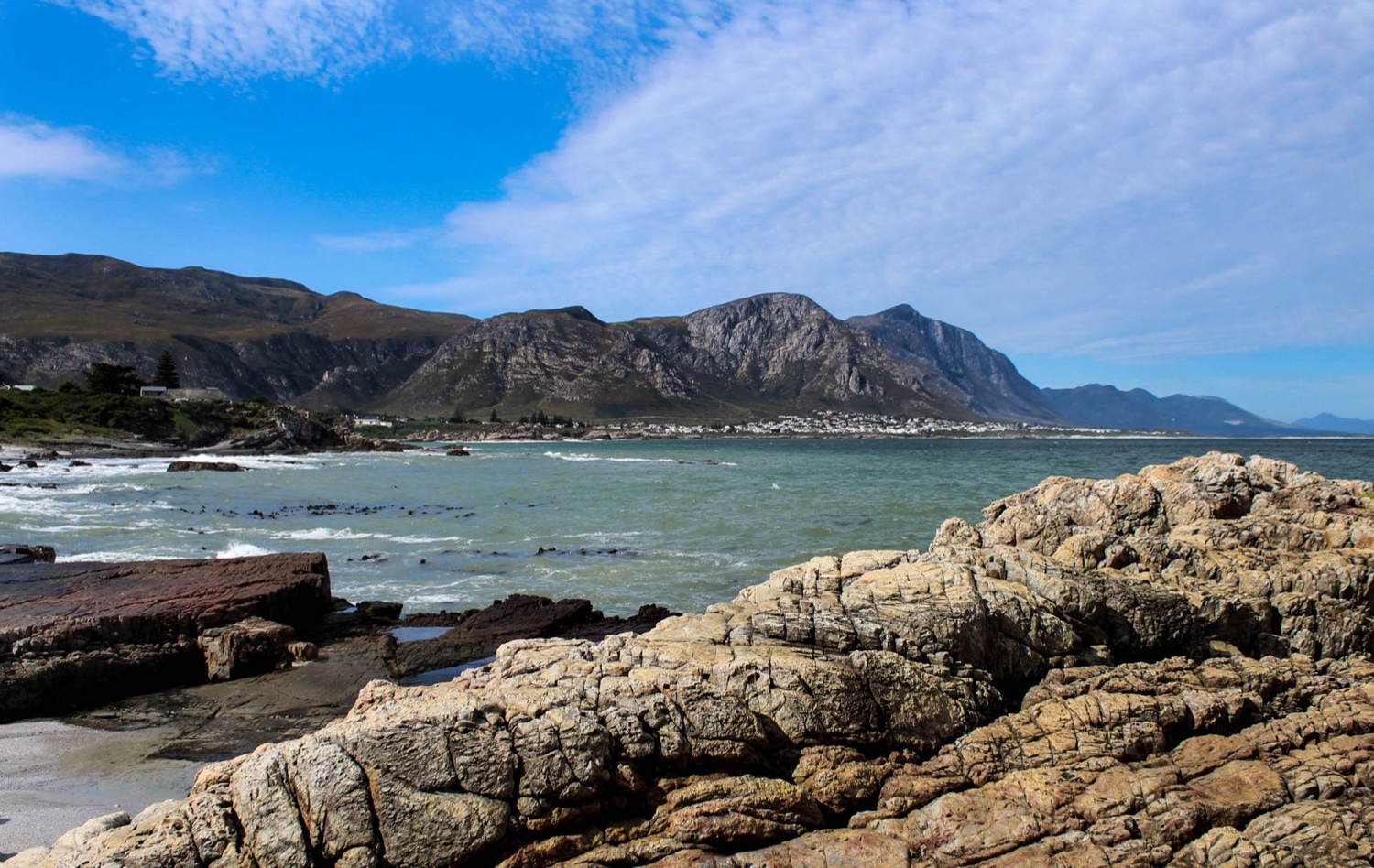
Looking back along Walker Bay from the eastern end of the path. Photo: Mimi / Pexels.
Where to actually stand
Gearing's Point is the obvious answer and it earns it: a natural amphitheatre of rock right above the Old Harbour, open around the clock, with the bay arranged in front of you like a stage. Come at eight and it is yours; come at eleven in season and you are sharing.
Sievers Point, about forty minutes east, is the one I would send you to if Gearing's feels crowded. Same water, a fraction of the audience.
Kwaaiwater, just past it, is where the path sits lowest and closest to the rocks, and it is the stretch where people most often describe whales appearing directly beneath them.
The Old Harbour Museum at 64 Marine Drive is worth the thirty minutes when the wind is up — open 09:00 to 16:30 Monday to Saturday and 11:00 to 15:00 on Sunday, with the old whaling-era boats pulled up outside. It reframes the bay you have been staring at.
Bientang's Cave, a hundred metres from the Old Harbour, is literally built into a cave in the cliff below Marine Drive. It is busy and it knows what it has, but eating lunch at sea level with whales in the bay is not a thing you do in many places. Monday to Thursday 10:00 to 16:00, Friday and Saturday 09:00 to 20:00, Sunday 09:00 to 16:00 — and book ahead in season.
Rotary Way, twelve minutes by car up behind the town, is the alternative when you want the whole bay at once rather than one whale up close. It is also the move on a day when the wind makes the waterline unpleasant.
For step-free walking, the central promenade between Gearing's Point and Sievers Point is the forgiving section — paved, railed, benched, with parking at both ends and short connections to Marine Drive. The western trail from the New Harbour is lovely and is not suitable for wheels or unsteady ankles.
Getting there, and what else is within half an hour
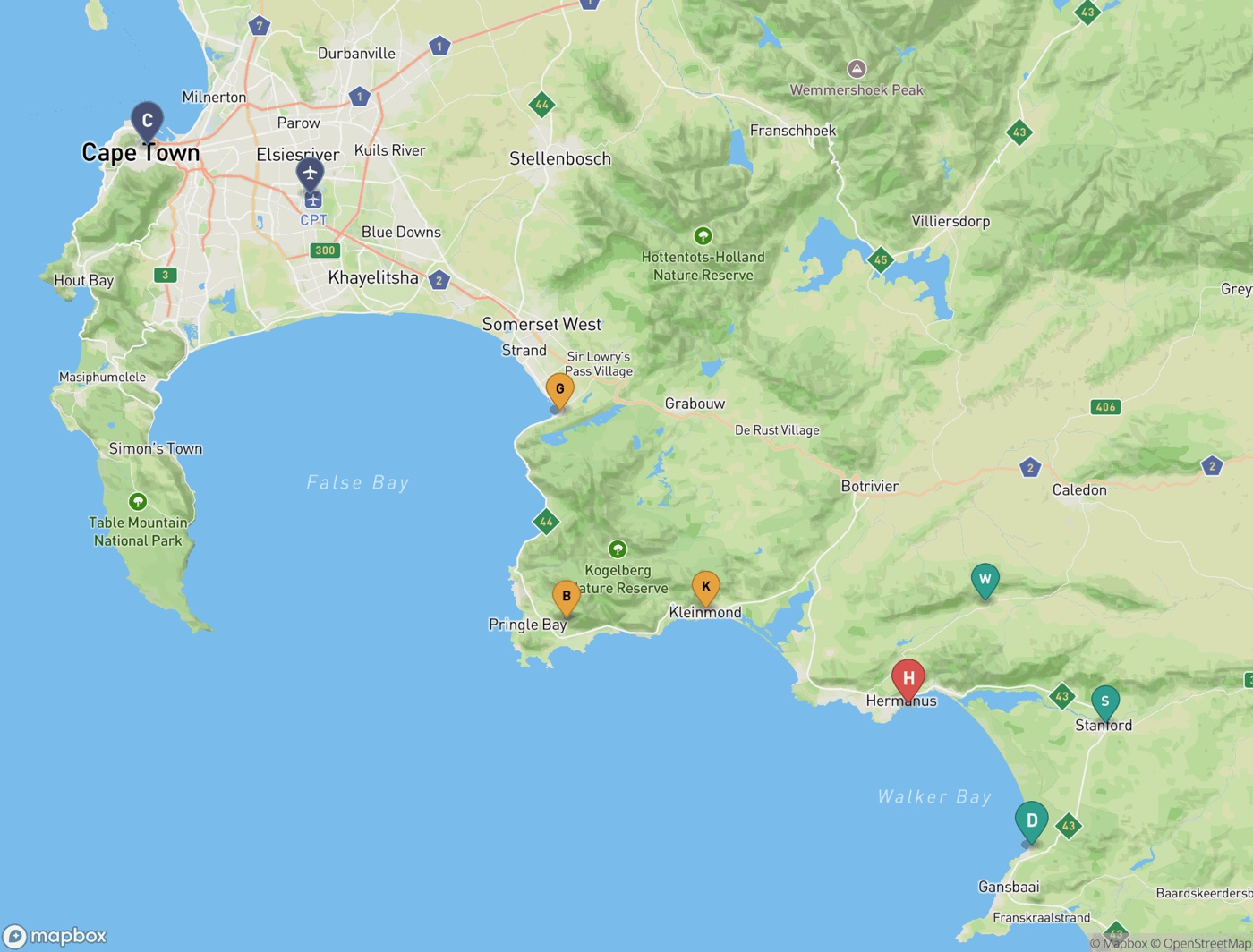
C Cape Town, G Gordon's Bay, B Betty's Bay, K Kleinmond, H Hermanus, W the Hemel-en-Aarde valley, S Stanford, D De Kelders.
From central Cape Town the fast way is about 119 km and an hour and a half over Sir Lowry's Pass. The other way — the R44 along Clarence Drive, hugging the coast through Gordon's Bay, Betty's Bay and Kleinmond — is 137 km and closer to two hours twenty, and it is one of the best coastal drives in the country. Take Clarence Drive on the way out, when you have the morning in hand and the light is on the water, and come back over the pass when you are tired. From the airport it is about 106 km and an hour and a half, which makes Hermanus a genuinely sane first stop off a long-haul flight.
If the Hermanus waterfront is heaving, De Kelders is 43 km and about 36 minutes around the bay. The Walker Bay Nature Reserve entrance on Normandie Street is open 07:00 to 19:00, the cliffs there look back across the same water with a fraction of the people, and the Klipgat Caves are a two-minute walk from the entrance.
Inland, Stanford is 23 minutes away and is a small, slow riverside village that makes a good rainy afternoon. The Hemel-en-Aarde valley starts at the edge of town: Hamilton Russell is ten minutes up the road and closed on Sundays, and Creation is 25 minutes further into the valley and open daily, 09:00 to 17:00.
Before you go
The season runs roughly from June into November, with the greatest numbers from August through October, and mothers with calves staying latest. That puts right now in the tail of it — still generous, no longer guaranteed. Bring binoculars if you own them; the difference between "I think that's a whale" and watching a calf roll is one piece of cheap optics. Bring a windbreaker regardless of the temperature. And stop at the Hermanus Tourism Bureau in the old station building on Mitchell Street — they will tell you where the animals have been sitting in the bay that week, which no forecast can.
If you are putting the days together, this is the kind of trip that rewards a bit of planning you can change — pin the viewpoints, watch the wind, and keep the inland afternoon in reserve. That is exactly the sort of juggling a travel buddy is good at: holding the plan loosely while the weather makes up its mind.
Then put the phone away for the last stretch of path. The blow carries further than the photograph does.
Continue wandering
One more story for the road
October 17, 2026 · Maya Roam
In Oaxaca, the Flower Fields Open Before the Crowds Arrive
Oaxaca's 2026 Dia de Muertos programme runs 26 October to 3 November, and it is not evenly weighted: the flower fields, the thirty Zocalo altars, the Jalatlaco sand tapestry and the craft fair are all front-loaded, whil…
Read nextInspired to go?