
Travel story 10 min read
MyTravelBuddy Stories
In Oaxaca, the Flower Fields Open Before the Crowds Arrive
Oaxaca's 2026 Dia de Muertos programme runs 26 October to 3 November, and it is not evenly weighted: the flower fields, the thirty Zocalo altars, the Jalatlaco sand tapestry and the craft fair are all front-loaded, whil…
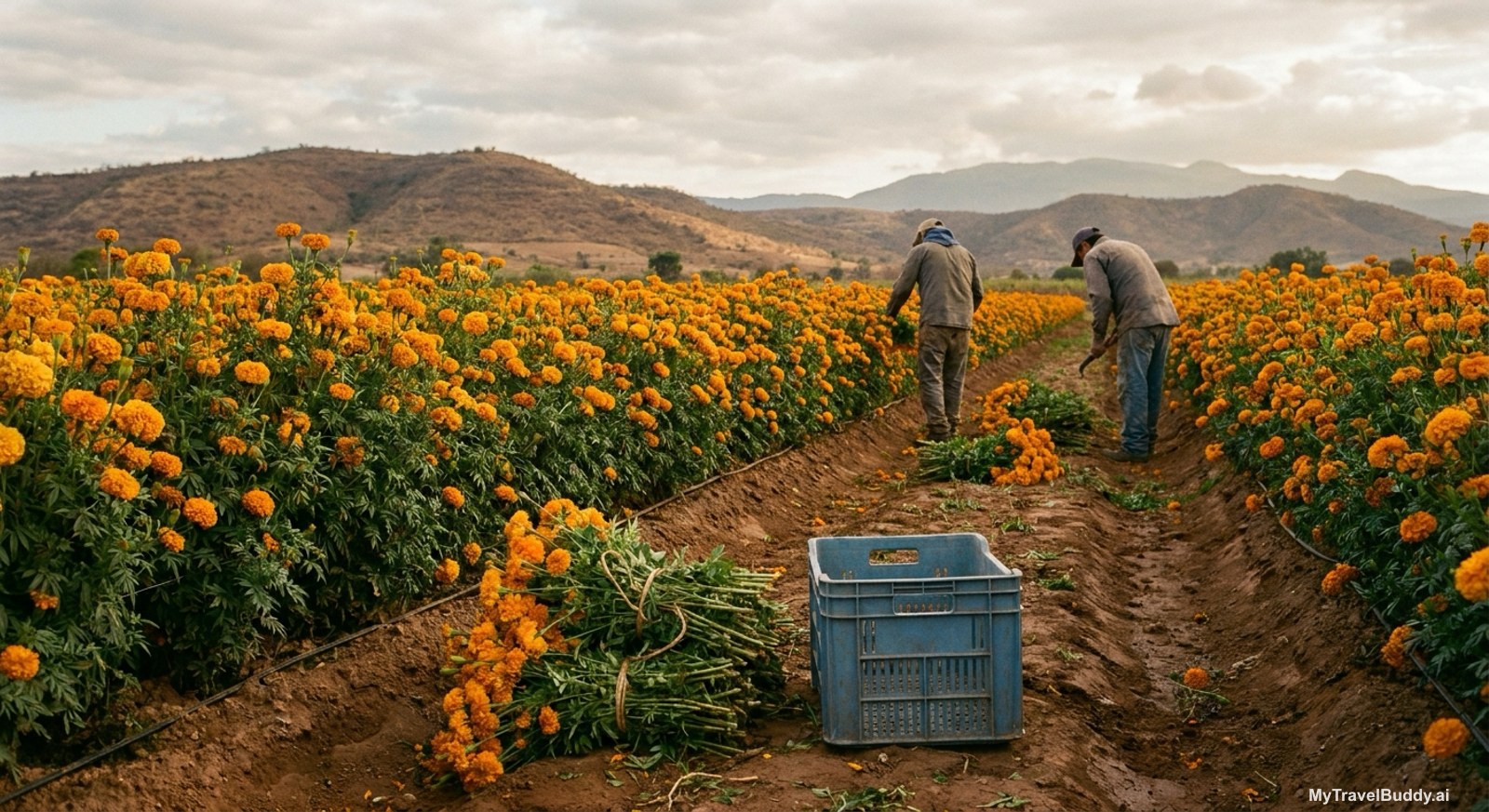
The marigolds are already being cut. Out in the Central Valleys south of Oaxaca city, in fields that look like somebody spilled a sunset across the furrows, people are bending into rows of cempasúchil with knives, laying the stems in bundles, tying them with twine, stacking them in crates at the edge of the drip line. The soil is still dark from the last of the rain. This happens every year in the last two weeks of October, and almost nobody schedules a trip around it, because almost everybody schedules a trip around the three nights at the end.
Here is the thing I want to put in front of you before you book: Oaxaca's official Día de Muertos programme in 2026 runs from 26 October to 3 November, and it is not evenly weighted. The flowers, the altars, the craft fairs and the village circuits are front-loaded. The crush — the big verbena, the grand comparsa, the cemetery nights — is back-loaded into the last four days. Which means there is a quiet, fully-lit, completely legitimate version of this festival sitting in the first half of the programme, and the hotel rates haven't noticed it yet.
If you can only move a few days on your calendar, move them to Monday 26 through Wednesday 28 October.
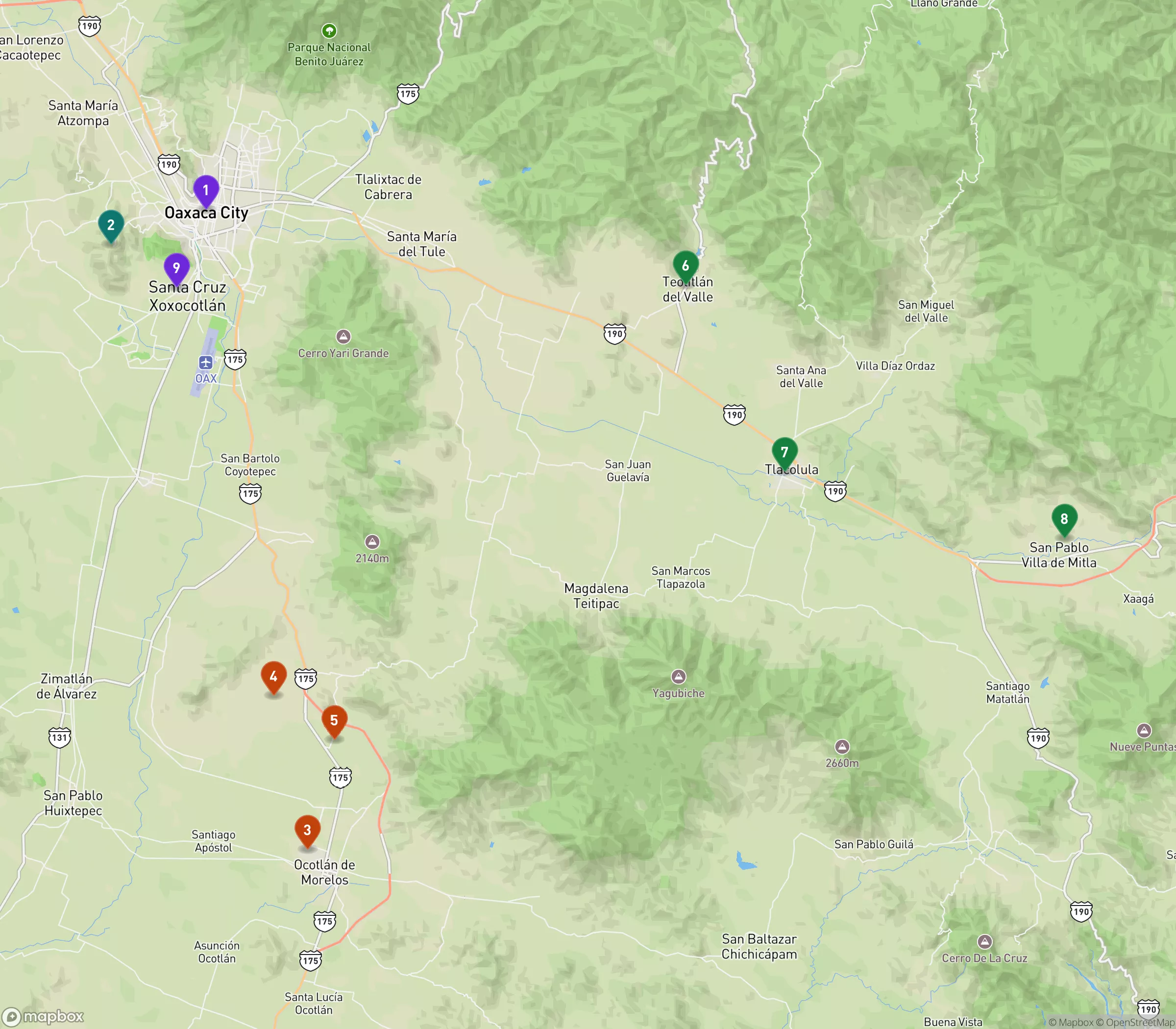
Two arms out of one city. South to the flowers: San Antonino (3) is 21 miles but about 57 minutes, with Tilcajete (4) and Jalieza (5) on the way. East to the markets and ruins: Tlacolula (7) is 19.7 miles and about 48 minutes, and its tianguis is a Sunday. Monte Alban (2) is 24 minutes from the Zocalo (1); Xoxocotlan (9) is 18 minutes on an ordinary night, and far longer on the 31st.
What's actually happening, and when
Oaxaca's state government announced this year's programme — La Fiesta Más Viva de Todas — on 6 October, with more than a hundred activities. The dates worth writing on your hand:
- 24 October – 1 November. The sixth Festival del Corte de Flor de Cresta de Gallo at the paraje El Horno in San Antonino Castillo Velasco. The cockscomb cut. This one opens two days before the official city programme does.
- 26 October – 3 November. The flower circuit, Flores que Guían el Alma, running out to fields at San Jacinto Amilpas, San Antonio Arrazola, San Martín Tilcajete, Santo Tomás Jalieza, Teotitlán del Valle and Mitla. Routes depart from Parque Juárez, the park everyone calls El Llano.
- From 26 October. Thirty monumental altars go up in the Zócalo, representing the state's sixteen Indigenous peoples and the Afro-Mexican community. A 250-square-metre sand tapestry is laid in the atrium of the Templo de Jalatlaco by three artists.
- 28 October – 4 November. Casa Hecho en Oaxaca at the Real Alhóndiga de Antequera: ninety artisans and ten producers, under the theme Ofrenda y Herencia.
- 30 October, 7pm. The Verbena Xandú in the Zócalo — tamales, pan de muerto, chocolate and coffee, given away free. This is where it tips.
- 31 October. The Gran Comparsa from the Calzada Porfirio Díaz down to García Vigil, the façade contest through the historic centre, the catrina contest on the Alameda de León. And the cemetery vigil at Xoxocotlán that night.
- 1–2 November. The Panteón General, and then the village graveyards.
Read that list again and notice the shape of it. By Tuesday the 27th, the altars are standing, the sand tapestry is finished, the flower fields are open and the craft fair is about to start. The only things you miss are the three events that draw the largest crowds Oaxaca sees all year. In 2025 the season brought roughly 86,900 visitors and 383 million pesos into the state, and about three-quarters of those visitors came from outside Mexico. They do not arrive evenly. They arrive for the weekend.
The southern arm: go for the flowers
The flower villages are south of the city, strung along the road to Ocotlán, and this is the drive people consistently underestimate. The Zócalo to San Antonino Castillo Velasco is 21 miles — but budget about 57 minutes, not the half hour the distance suggests. It is a valley road through a chain of towns, not a highway, and every one of those towns has topes and a market day.
Break the drive rather than fighting it. San Martín Tilcajete is on the way, at about the two-thirds mark, and it's the alebrije village — the carved and painted wooden figures. Santo Tomás Jalieza is a few minutes further on, and it's backstrap-loom weaving, mostly worked by women's cooperatives. Both are small enough to see properly in forty minutes each and both are considerably more pleasant on a Tuesday than they will be on the 31st.
San Antonino is the flower town. In recent years the growers there have also run an illuminated field in the evenings — paid entry, food stalls, music, bonfires among the rows. I'd check their own Facebook page for this year's dates and hours before driving out at dusk rather than trusting a listicle, because the schedule has shifted between editions and it's a community operation, not a municipal one.
One piece of etiquette that matters more than it sounds: these are working parcels, and the people in them are mid-harvest on the most commercially important week of their year. Ask before you photograph anyone, buy a bunch of flowers, and don't walk into rows that haven't been cut.
The eastern arm: pick two, not five
The other direction, east along Highway 190, is the famous one — Santa María del Tule and its enormous cypress, Teotitlán del Valle for rugs, the Tlacolula market, Mitla, and then Hierve el Agua at the far end.
Do not try to chain all of them. I ran the whole sequence as one route and it comes out at 54.7 miles and about two and a half hours of driving, before you've stopped anywhere, and the last leg alone — Mitla out to Hierve el Agua — is 20 miles and 52 minutes on a road that climbs and narrows. That's a day where you see five places through a windscreen.
Two realistic shapes instead. Either Tule, Teotitlán and Tlacolula as a half-day loop, back in the city by mid-afternoon; or Mitla and Hierve el Agua as a full committed day out, leaving early. The Tlacolula market is a Sunday tianguis — the Sundays in your window are the 25th and the 1st, and the 1st is Day of the Dead itself, so if the market matters to you, the 25th is effectively your only civilised option this year. It's 19.7 miles and about 48 minutes from the Zócalo, and it is worth being there before ten.
The city, on foot, in a single afternoon
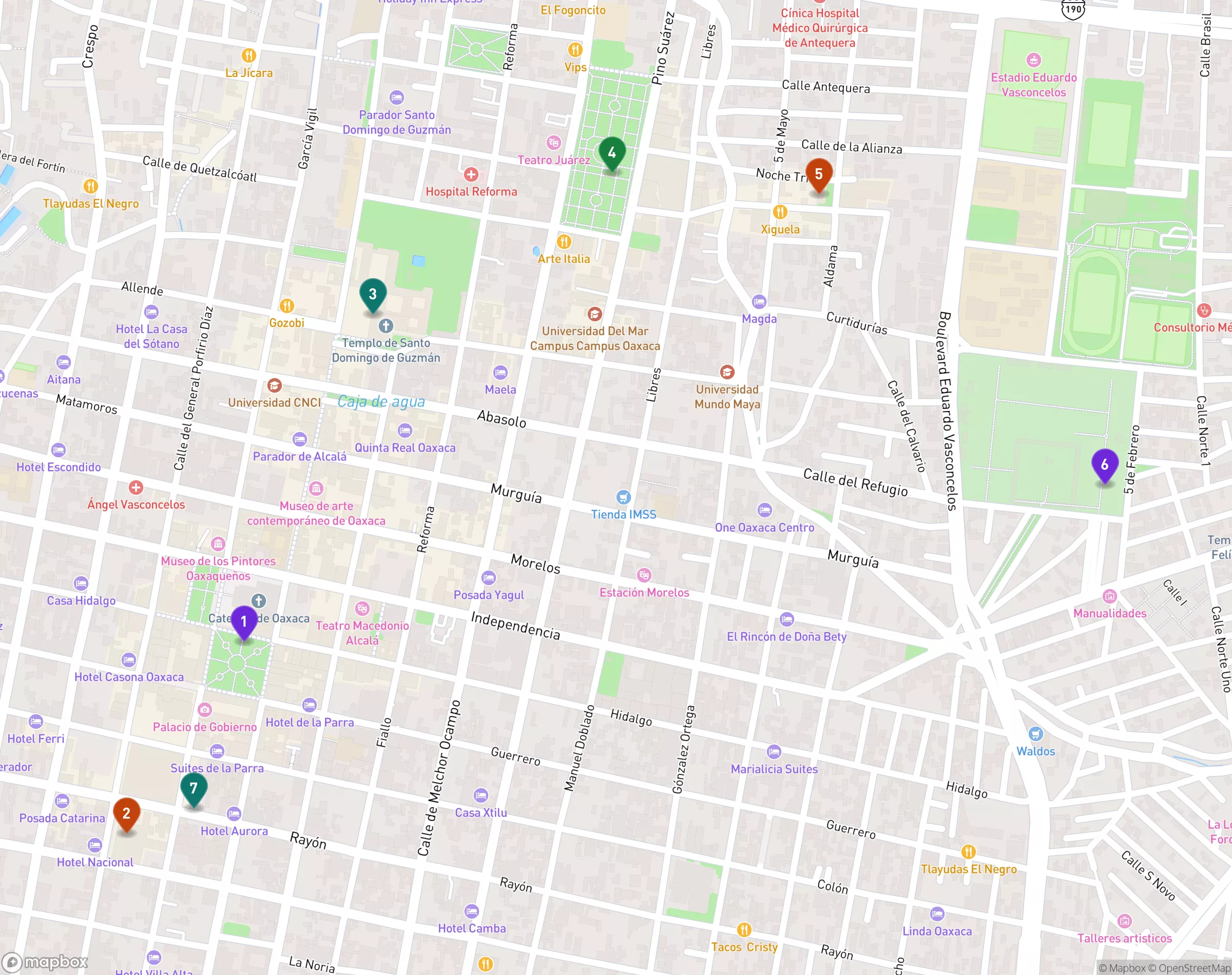
The whole festival city on foot: 1.7 miles and about 39 minutes of walking from the Zocalo (1) through Santo Domingo (3) and Jalatlaco (5) to the Panteon General (6). Thirty monumental altars stand at 1; the 250-square-metre sand tapestry is laid in the atrium at 5; the flower-field routes depart from El Llano (4); and Casa Hecho en Oaxaca runs at the Real Alhondiga (7) from 28 October.
The good news about Oaxaca's historic centre is that the entire festival version of it fits inside a walk of 1.7 miles, roughly 39 minutes of actual walking, which realistically becomes an afternoon once you start stopping.
Start at the Zócalo with the thirty altars, and eat first — the Mercado 20 de Noviembre is two blocks southwest, and the smoke hall where they grill meat to order is the thing to do once and then talk about for a year. Walk north up the Alcalá to Santo Domingo, which has the gilded interior that makes people go quiet, and the Jardín Etnobotánico behind it in the old monastery grounds, which is guided-visit only and worth booking.
From there cut east to El Llano, where the flower-field routes depart, and then down into Jalatlaco — the cobbled barrio with the painted walls and the Templo de San Matías, where the sand tapestry is laid. It's about fourteen minutes' walk between those two, and Jalatlaco is the neighbourhood I'd pick for an evening meal in this window. Carry on another fourteen minutes east and you reach the Panteón General, which is where the city's own vigil happens on 1 November and which is quiet, green and genuinely lovely in the days before.
Weather, altitude, and what to put in the bag
I pulled the forecast on 17 October, so treat this as a forecast rather than a promise — but the shape of it is unusually clear this year. The rain is ending. Through to about the 22nd the valley is still getting drizzle and at least one thunderstorm, with precipitation chances running 51–70%. From roughly 23 October onward the forecast goes dry, with daytime highs in the comfortable 23–26°C range.
The part people get wrong is the nights. Oaxaca city sits at about 1,550 metres, and in that same dry stretch the overnight lows drop to around 9–14°C, with fog flagged for the mornings of the 24th and 25th. So: a proper layer for evenings, something warm for an early start to Monte Albán or Hierve el Agua, and sunscreen regardless, because the altitude does not care that the air feels mild.
Monte Albán is your weather hedge, incidentally — 5.6 miles and about 24 minutes from the Zócalo, high on its flattened ridge above the valley. Go early for the light and the empty plazas.
If you can only come for the big nights
Then come for the big nights, and I mean that without any sarcasm. The cemetery vigils are the heart of this and nothing I've written replaces them. Just arrive knowing what you're walking into: Xoxocotlán is 3 miles and about 18 minutes from the Zócalo on a normal day, which on the night of the 31st means a very short distance and a very long time. Book accommodation months out. Go with a local guide if you can. And remember you are a guest at a family's graveside — bring flowers or a candle, ask before photographing, keep your voice down, and don't step over a grave to get a better angle.
The short version
The best week in Oaxaca this year is not the famous one. It is the three days where the altars are already standing, the sand is already laid, the fields are open and lit, the rain has just stopped, and the city is still roughly the size it is in September. Fly in on the 25th, take Tlacolula that Sunday morning, give the 26th to the southern flower villages, the 27th to the centre on foot, and the 28th to Mitla or Monte Albán.
Then decide, once you're there and you've seen how it feels, whether you want to stay for the 31st. Plenty of people do. But you'll have already seen the part of Día de Muertos that happens in a field, in daylight, with a knife and a ball of twine — and that part is arguably the one the whole festival is built on.
Continue wandering
One more story for the road
October 16, 2026 · Maya Roam
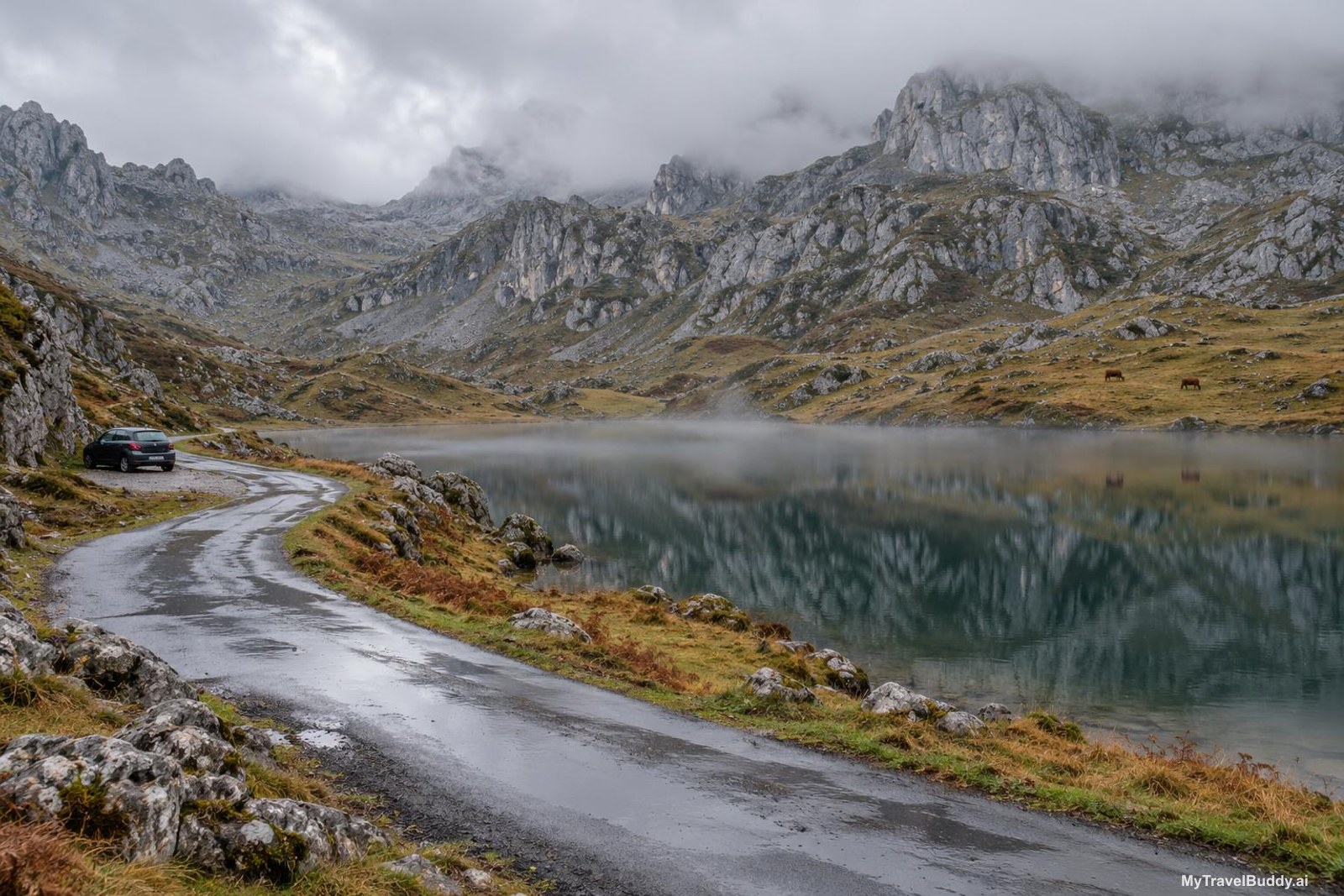
Covadonga Without the Shuttle
For four and a half months you could only reach the Lagos de Covadonga on someone else's bus. That ends on Monday the 19th, and it ends in the same week the Ruta del Cares was cut at two bridges for repairs. Inside: the…
Read nextInspired to go?