
Travel story 11 min read
MyTravelBuddy Stories
Pick One Waterhole and Wait: Etosha Before the Rain
By early October, Etosha has gone about six months without meaningful rain, the pan is a dry saltflat, and every thirsty animal in the park is funnelled into a handful of known waterholes. Then the forecast turns: rain…
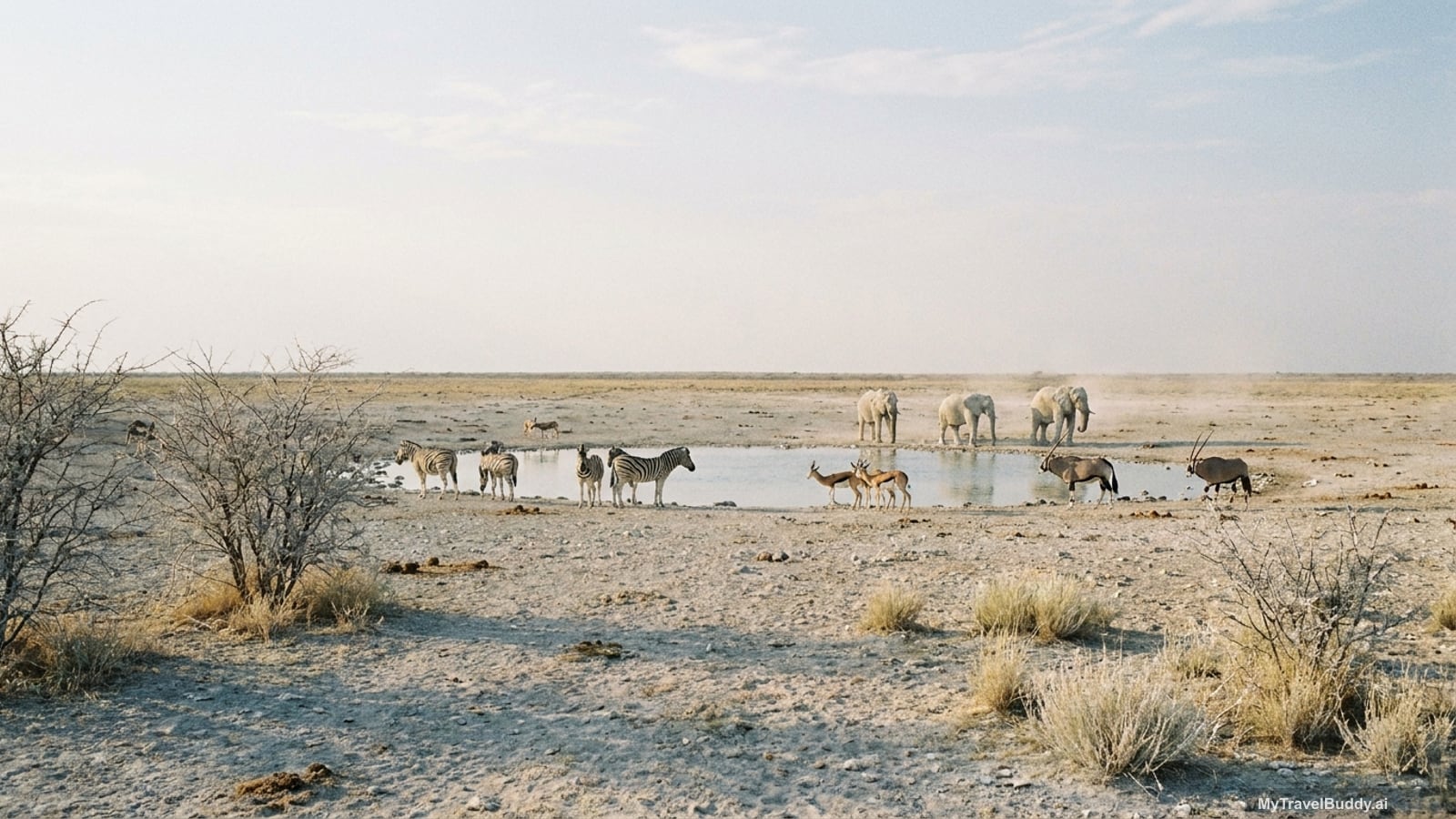
Most of what you have been told about a game drive is about movement. Leave early, cover ground, chase the radio call, come back with a list. Etosha quietly rewards the opposite instinct, and never more than right now, in the last dry week before the weather turns.
By the first days of October the park has been without meaningful rain for roughly half a year. The grass is bleached to straw, the thorn scrub has dropped most of its leaves, and the great white pan at the centre of the park is a dry saltflat that holds nothing at all. Which means the water is not where the animals are. The animals are where the water is — and in Etosha, the water is in a finite, known, mapped set of springs and pumped waterholes, most of them a short drive from the three main camps.
So you do not have to find anything. You have to choose a waterhole, park, turn the engine off, and stay long enough for the park to forget you are there.
Where this is, and how long the approach really takes
Etosha sits in the north of Namibia, and the number that surprises most first-time visitors is the drive in.
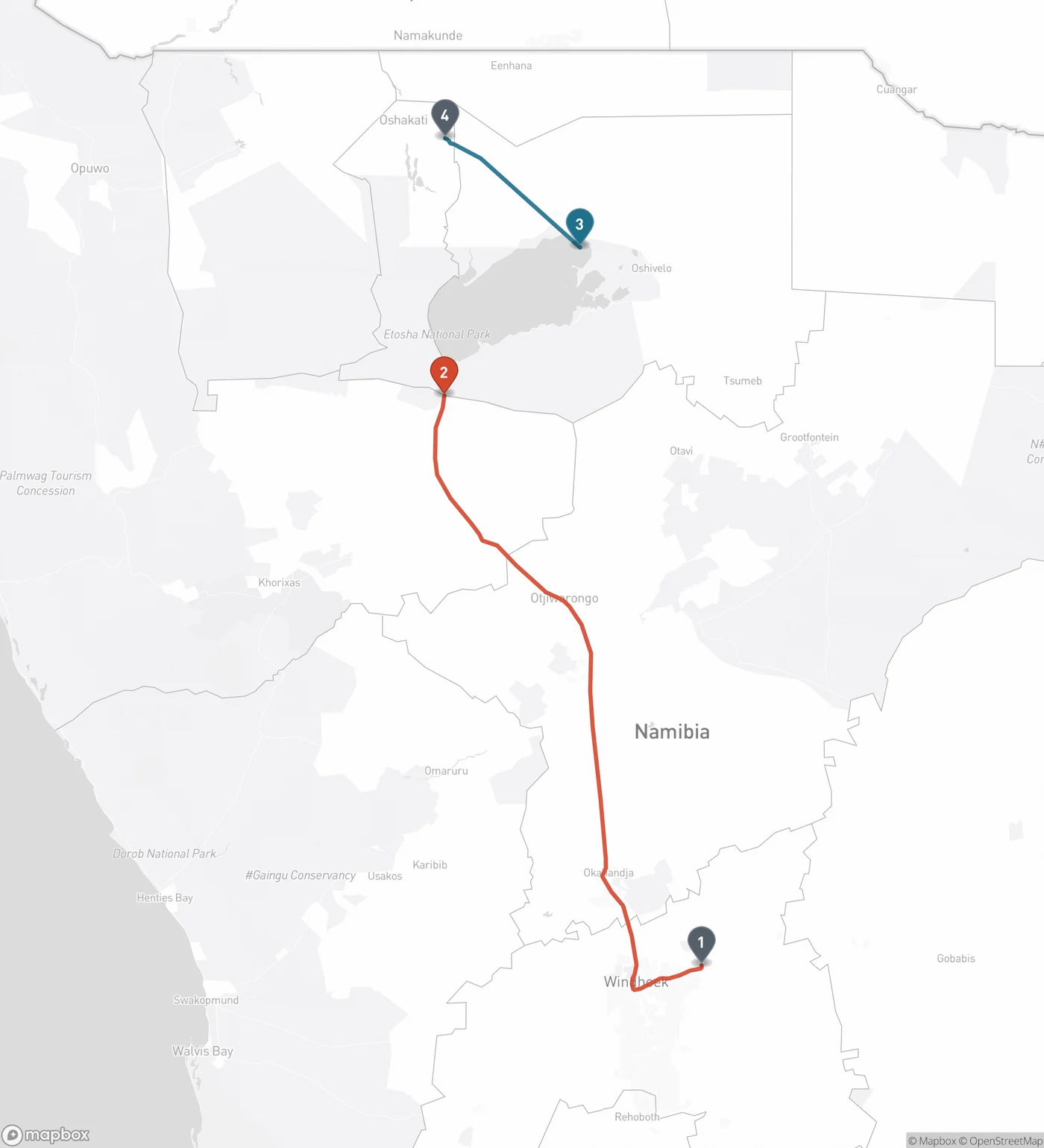
1 Hosea Kutako International Airport, Windhoek. 2 Andersson Gate, the southern entrance. 3 King Nehale Gate in the north. 4 Ondangwa. The red line is the standard approach — 468 km and about four and a half hours. The blue line is the shortcut almost nobody uses.
From Hosea Kutako International Airport outside Windhoek to the Andersson Gate is 467.8 km and roughly 4 hours 40 minutes on good tar, mostly the B1 and the C38 through Okahandja, Otjiwarongo and Outjo. Add the gate formalities and another 18 km / 24 minutes on to Okaukuejo and you have burned the better part of a day. Fly in and drive the same day and you will arrive tired, late, and in the worst possible frame of mind for an activity whose entire technique is patience.
Give the approach its own day. Sleep in Otjiwarongo or Outjo, or eat the cost of a night at a lodge just outside the southern gate, and start your first morning already pointed at the park.
The shortcut, if you are moving around northern Namibia anyway: Ondangwa to the King Nehale Gate is only 110.7 km / about 1 hour 32 minutes. If your route includes the north, flying into Ondangwa instead of Windhoek turns a four-and-a-half-hour approach into ninety minutes.
Why this particular week
The forecast is doing something specific, and it is the reason to write about Etosha today rather than in a month.
Through 4–8 October the three camp areas show no rain at all and daytime highs climbing from about 33°C to 35.6°C at Okaukuejo. Nights are still properly cold — the overnight minimum at Okaukuejo drops to around 13°C on 5–6 October. That spread is the end-of-dry-season signature: brutal afternoons, sharp mornings, dust in the air, and every thirsty animal in the park funnelled into the same handful of pools.
Then it shifts. From 9 October onward rain probability at Okaukuejo climbs into the 30–43% band, and Namutoni's forecast carries real totals — around 8 mm on the 10th and 17 mm on the 12th. At the same time the overnight minimum at Okaukuejo jumps from 13°C to about 22°C. The nights stop cooling. That is humidity arriving, and humidity is the first announcement of the wet season.
The first rains change Etosha completely, and quickly. Temporary pans fill across the park, the animals disperse because they no longer need the permanent water, the grass greens, and the thing that makes October extraordinary simply stops being true. It is not that the park becomes bad — the calving season and the birdlife that follow are their own reward — but the waterhole concentration goes away.
Treat these as forecasts, not guarantees; a 40% probability is not a promise of rain, and the first storms often take another two or three weeks. But the direction is unambiguous, and it is worth knowing which side of it you are booking.
The arithmetic that should change your plan
Here is the part that catches people out. Etosha's interior roads are gravel, the speed limit is low, and the distances are not what the map suggests.
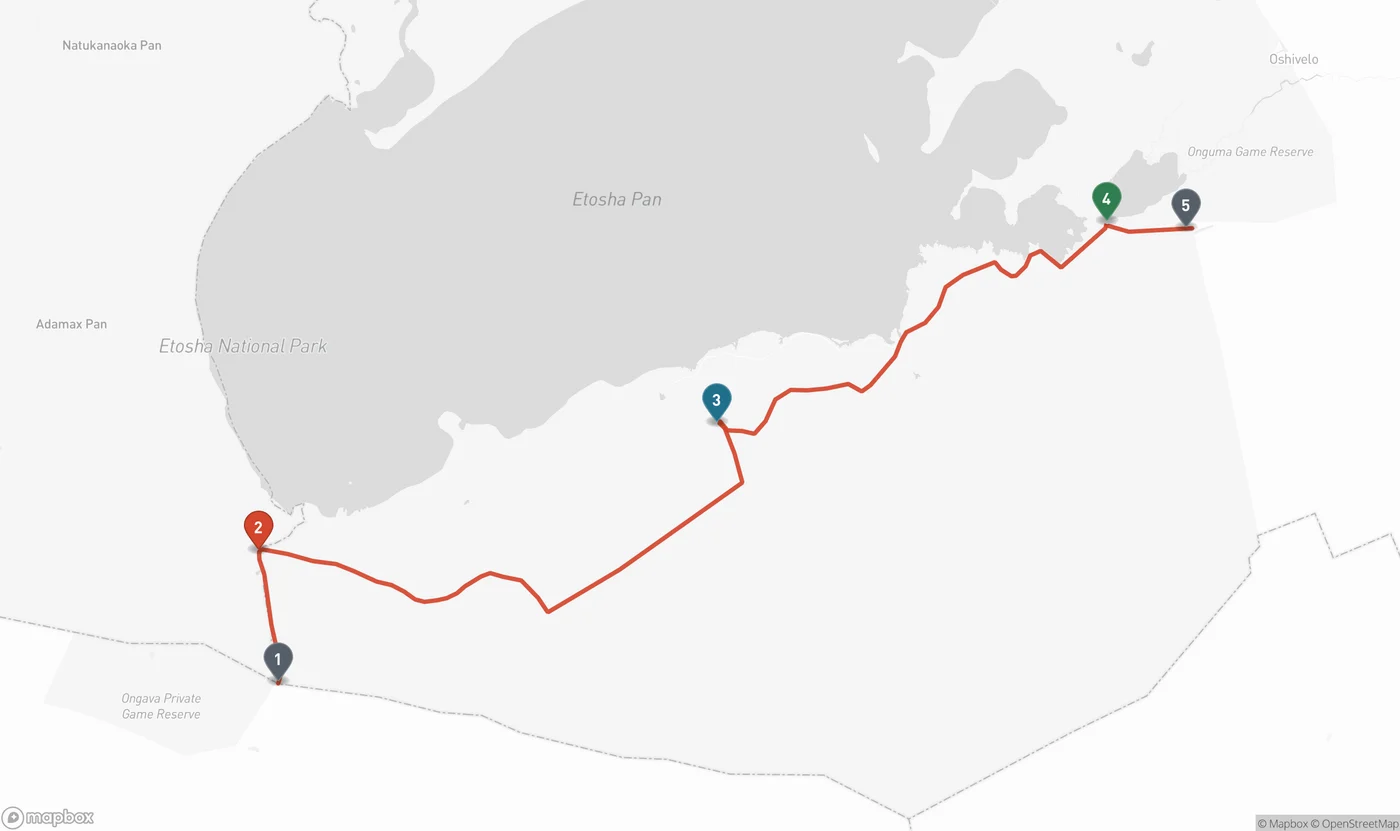
1 Andersson Gate. 2 Okaukuejo. 3 Halali. 4 Namutoni. 5 Von Lindequist Gate. The road is essentially one long arc along the southern rim of the pan — which is why camp-to-camp transfers cost so much more time than the distances imply.
- Okaukuejo to Halali: 83.2 km, about 2 hours 4 minutes.
- Halali to Namutoni: 70.3 km, about 1 hour 27 minutes.
- Okaukuejo straight through to Namutoni: 149.1 km, about 3 hours 24 minutes.
That is an average of roughly 40 km/h. Now put it against the day you actually have: on 3 October the sun rises at Okaukuejo around 06:36 and sets around 18:54, and Etosha's gates open at sunrise and close at sunset. There are no fixed published hours — the times track the sun and are posted at each gate — and you must be inside your camp by closing. Driving in the park after dark is not allowed except on an authorised night drive from camp.
So the window is about twelve and a quarter hours. A camp-to-camp transfer eats a quarter to a third of it, and it does so in the middle of the day, in 35°C heat, during the exact hours when the animals are lying in whatever shade they can find and nothing is moving. You will spend three hours on gravel to see almost nothing, and arrive too late for the afternoon.
Against that, from Okaukuejo: Nebrownii is about 8 km east. Okondeka is 22.3 km north — a 32-minute drive. A whole excellent day fits inside a twenty-five-kilometre radius.
The plan that works is not a loop. It is: two nights minimum per camp, waterholes in the first two hours after the gates open and the last two before they close, and the entire middle of the day spent back in camp under a tree or in the pool, doing nothing.
The camps, and why the floodlights matter
The three main camps inside the park are run by Namibia Wildlife Resorts, and each has its own floodlit waterhole on the perimeter fence — a viewing area, a low wall, benches, and a light left on all night. This is the single best reason to sleep inside the park rather than at a lodge outside the gate. After sunset, when every private vehicle in Etosha is legally parked, the waterhole in front of your camp keeps running.
Okaukuejo is the famous one, and deservedly. NWR lists black rhino, lion and elephant as common sightings at its floodlit waterhole, and it is a genuinely strange experience: a semicircle of people in camp chairs at ten at night, silent, watching rhino come in out of the dark one at a time. If you book anything at Okaukuejo, book a Waterhole Chalet — the premium is real, and it buys you the ability to go back and forth between your bed and the viewing wall all night.
Halali sits at the base of a dolomite hill in thicker mopane woodland, which gives it a different cast of visitors; NWR flags leopard, rhino and elephant. Its Moringa waterhole is smaller and more intimate than Okaukuejo's amphitheatre, and the camp is well placed for the central waterholes and for the Etosha Pan Lookout, 22.4 km / about 30 minutes away — the one place where you are allowed out of the vehicle to stand on the pan itself and look at a horizon with nothing in it at all.
Namutoni is built into a white German fort from 1897 at the eastern end of the park, overlooking the floodlit King Nehale waterhole, and it is the one to choose if you care about birds — Fischer's Pan is right there. It is also 13 km / 17 minutes from the Von Lindequist Gate, which makes it the painless place to start or finish a traverse.
A gentle note on cost and timing: NWR prices in two seasons, and the line falls on 1 November. An Okaukuejo Waterhole Chalet is NAD 3,480 per person sharing through October and NAD 2,380 from November; camping drops from around NAD 550 to NAD 460. The rains and the price cut arrive in the same week, which is its own kind of honest trade.
Practical things worth getting right
- Book camps early. The three in-park camps are small — Okaukuejo has 37 campsites and a few dozen chalets — and October is still high season. Waterhole chalets go first.
- Park fees changed on 1 April 2026. The Ministry of Environment, Forestry and Tourism schedule now lists NAD 280 per day for international adults, NAD 180 for SADC adults and NAD 60 for Namibians, with children under nine free and a vehicle fee of NAD 60 for cars up to ten seats. Several travel sites still quote the older NAD 150 / NAD 50 figures, so budget for the new numbers and confirm at the gate.
- A 2WD sedan is fine on the main gravel circuit in the dry season. High clearance is more comfortable and gives you a better eye line; it is not a requirement.
- Stay in the vehicle except at the marked picnic sites, camp gates and the pan lookout. This is not a formality — Etosha has lion and black rhino, and the open ground gives you nothing.
- Fill up in camp. Okaukuejo, Halali and Namutoni all have filling stations. There is nothing between them.
- Bring more water than feels reasonable, plus a hat you can wear sitting down, and binoculars rather than a longer lens if you have to choose. At a waterhole the animals come to you; what you need is the ability to watch them properly for an hour.
- Guided drives are available from every camp — around NAD 650 for a morning or afternoon drive and NAD 750 for a night drive. The night drive is the only legal way to be out on the roads after dark, and in the last dry week it is worth the money.
How to actually sit at a waterhole
This is the part no itinerary tells you, and it is the whole skill.
Arrive before the animals do. Switch the engine off. Do not slam doors. Give it forty-five minutes before you decide it is not working — the first twenty are usually empty, and the shift happens all at once, because animals arrive in a rough order and watch each other to decide whether it is safe. Zebra and springbok come in loose and nervous. Oryx take their time. Elephants clear everything else out by simply walking in. Giraffe are last and most reluctant, because splaying their front legs to drink is the most vulnerable thing they do all day.
If nothing has happened in an hour, move once — not five times. Pick the next waterhole on the same stretch of road and repeat. Two waterholes done properly will beat eight done at 40 km/h.
And this is the point where a travel buddy actually earns its place: not for finding the park, which is easy, but for keeping the small things straight while you sit still — which waterhole you were at when the light was good, what time the gate closes tonight, how far Okondeka is from where you are parked, and what you saw and when, so the week does not blur into one long dusty afternoon when you try to tell someone about it later.
Etosha in the first days of October is not subtle. It is hot, it is dusty, the light is hard until an hour before sunset, and the ground is the colour of old bone. It is also, for a few more days, a place where the entire wildlife population of a park the size of a small country is obliged to come and stand in a handful of known locations in front of you.
You do not have to go looking. You just have to be there first, and be willing to wait.
Continue wandering
One more story for the road
October 2, 2026 · Maya Roam
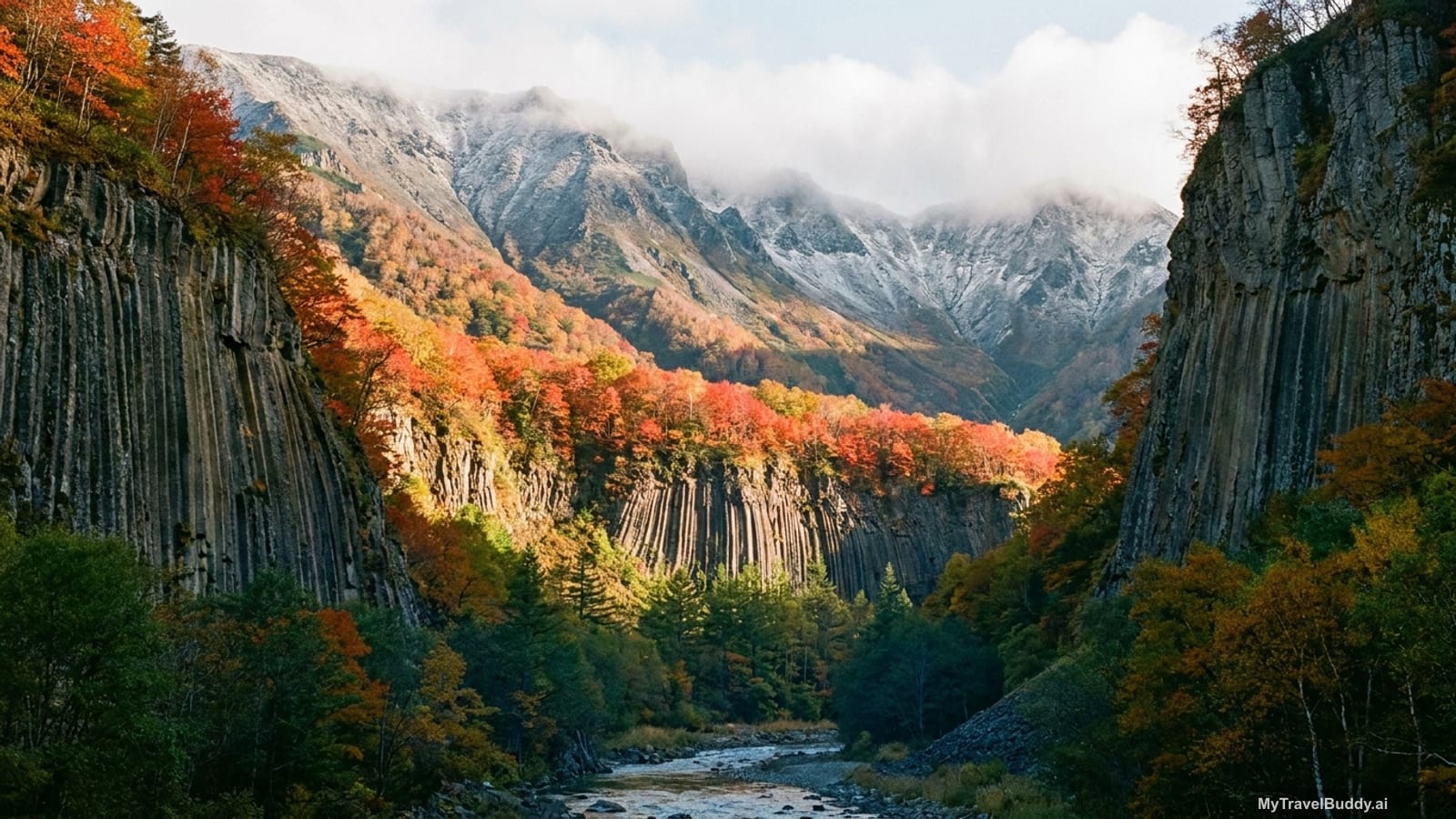
In Daisetsuzan, the Color Is Already Below the Summit
Japan's autumn season opens on a volcanic massif in central Hokkaido, and in 2026 it already peaked — the Asahidake ropeway's 1,600-metre station is reporting snow and −2°C while Asahikawa sits near 20°C. Here is where…
Read nextInspired to go?