
Travel story 7 min read
MyTravelBuddy Stories
Pack for Two Climates: Uzbekistan in the First Week of October
Bukhara is forecast at 35°C next Saturday and 19°C two days later. That break is why early October is the best week to ride the Afrosiyob from Tashkent to Samarkand to Bukhara — with the opening times, station distances…
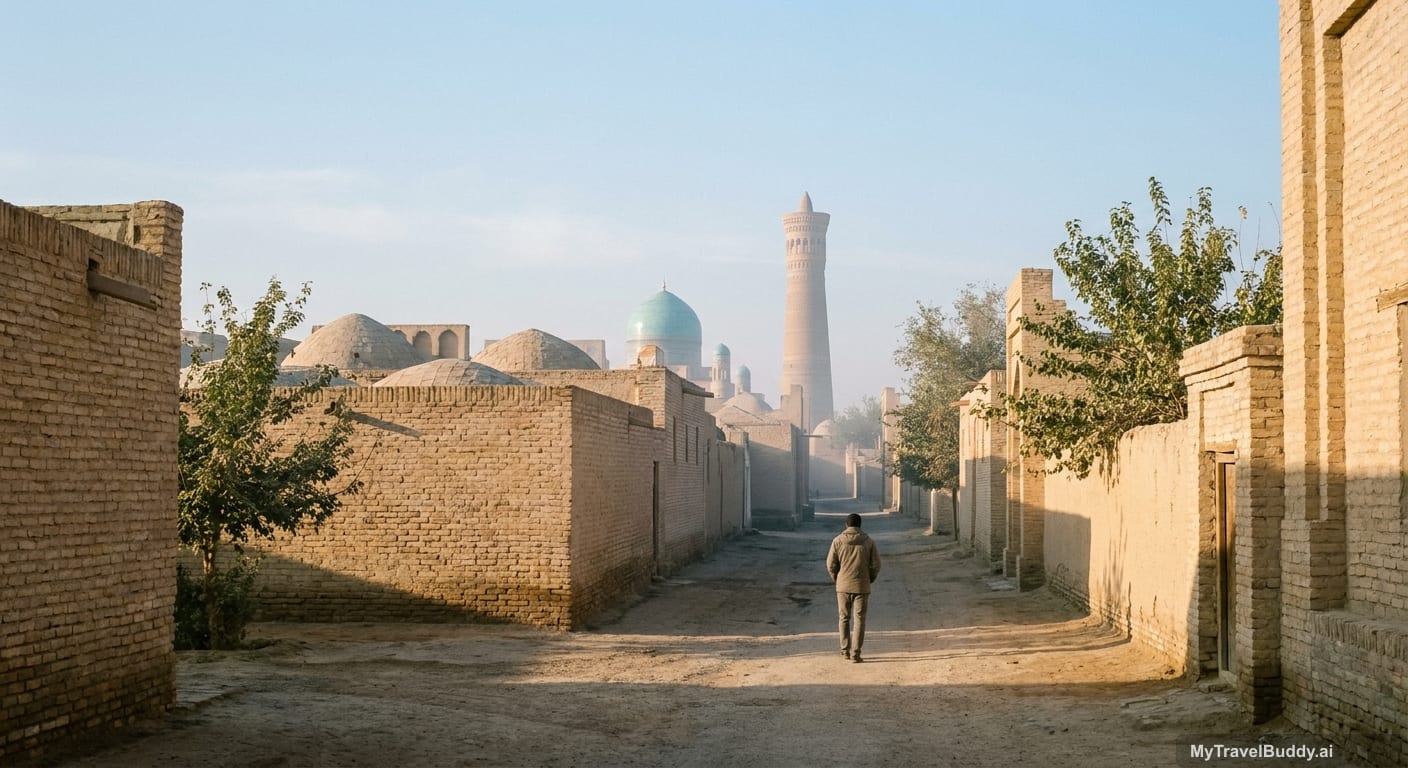
The forecast for Bukhara next Saturday says 35°C. The forecast for Bukhara the following Monday says 19°C. Same city, same week, a sixteen-degree drop in forty-eight hours — and that gap is the whole reason early October is my favourite time to cross Uzbekistan by train.
Most people arrive with one bag packed for one climate. Then the front comes through somewhere between Samarkand and Bukhara, and they spend the second half of the trip buying a fleece at a bazaar. Pack for both, and you get the best version of this country: the light of autumn, the warmth of late summer, and monuments that are no longer punishing to stand in front of at two in the afternoon.
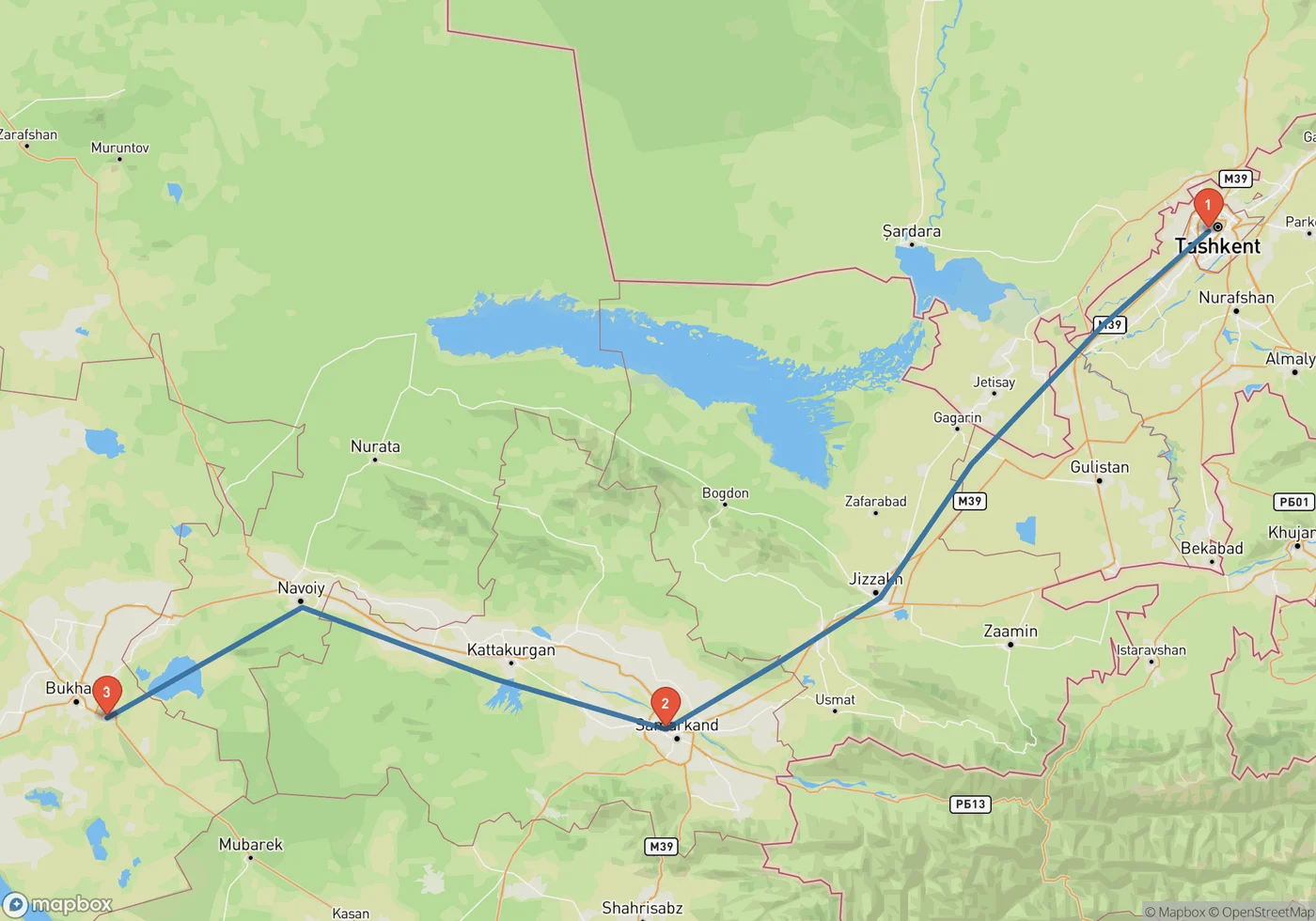
1 Tashkent, 2 Samarkand, 3 Bukhara. The blue line traces the rail corridor the fast trains follow — Tashkent out through Jizzakh, then west across the steppe past Navoi.
The train is the trip
You do not need a driver, and you do not need internal flights. The Afrosiyob — Uzbekistan's Talgo high-speed service — runs Tashkent–Samarkand–Bukhara and does Tashkent to Samarkand in a bit over two hours, Tashkent all the way through to Bukhara in something closer to three and a half. Samarkand to Bukhara on its own is the short, easy leg, and in economy class it costs roughly what a taxi across a European city costs.
Three things worth knowing before you book:
Tickets open about 45 days out on the state railway site, and the popular morning departures genuinely sell out in autumn. Book the trains before you book the hotels — the hotels will still be there.
Economy is fine. It's 2+2 seating, air conditioning, a tray table, a plug. Business buys you a wider seat in a 2+1 cabin, which matters on the long Tashkent–Bukhara run and is largely wasted on the 1h20 hop between Samarkand and Bukhara.
If the Afrosiyob is sold out, the slower Sharq intercity service covers the same ground in about three hours to Samarkand. It is not a downgrade worth agonising over.
Samarkand: go early, then disappear until five
Here is the thing nobody tells you about Samarkand. The monuments are not clustered the way the photographs imply, and the station is not in town.
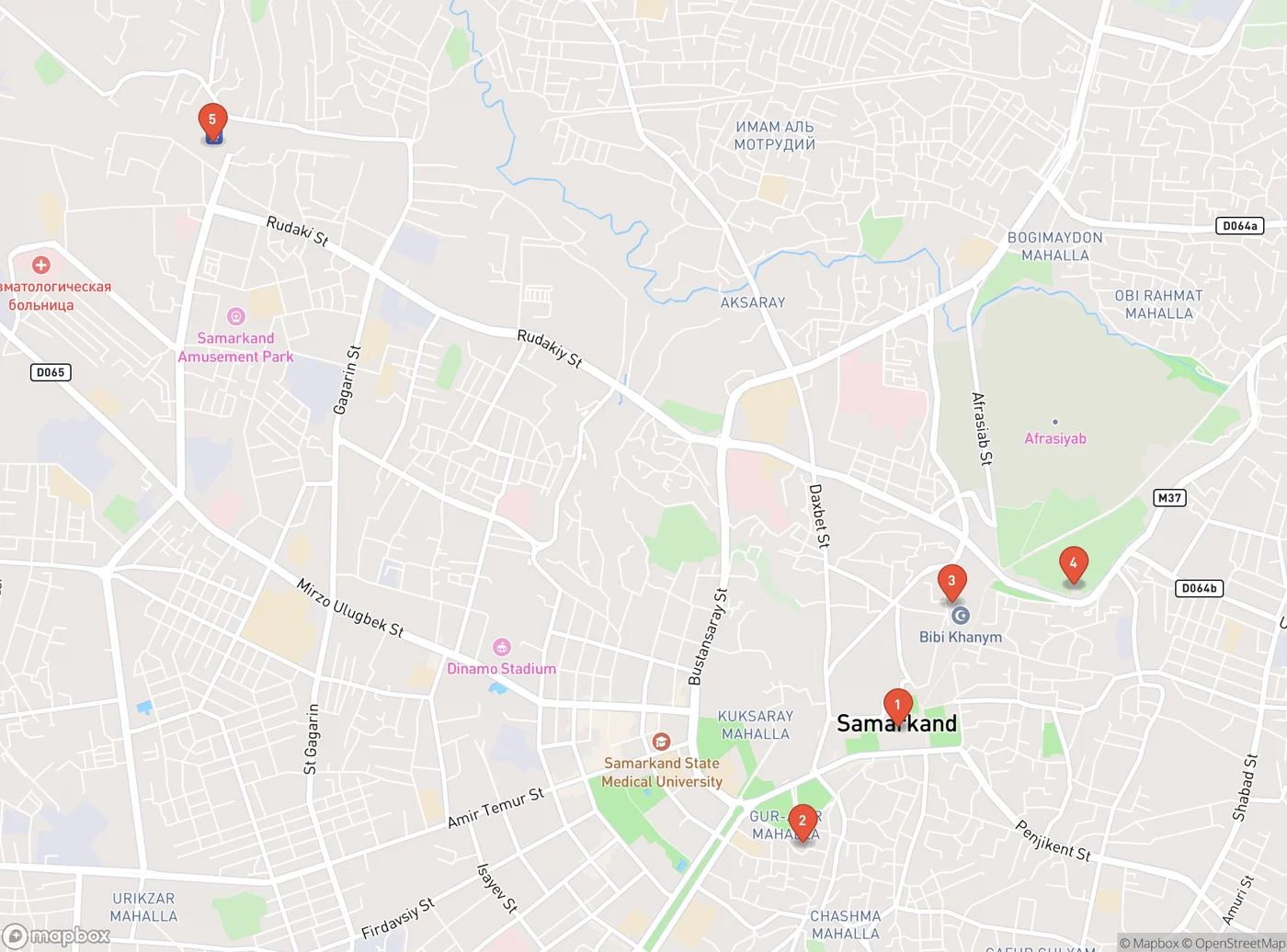
1 Registan, 2 Gur-e-Amir, 3 Bibi-Khanym and Siyob Bazaar, 4 Shah-i-Zinda, 5 Samarkand railway station.
The railway station sits about 6 km northwest of the Registan — roughly a 15-minute drive, longer if you land at the same moment as a full train. Arrange the ride, or expect to wait.
Once you're in the centre, distances are kind. The Registan to Gur-e-Amir is a 1.1 km walk, about fifteen minutes. The Registan up to Shah-i-Zinda is 2.5 km, call it half an hour on foot, and it is a pleasant walk in October in a way it absolutely is not in July.
Now the timing, which is where the two-climate week actually pays off. Shah-i-Zinda opens at 7 a.m. Bibi-Khanym opens at 7 a.m. on weekdays, 9 a.m. on Saturday and Sunday. The Registan does not open until 8. So: Shah-i-Zinda first, in the flat early light, before the tour groups form up — that narrow blue corridor of tombs is the single most photographed thing in the country and you can have twenty minutes of it nearly alone. Then Siyob Bazaar next door for bread and pomegranates, then Bibi-Khanym, then the Registan when it opens.
On a 32°C day — and the forecast currently has one of those next Saturday — stop there. Go back to the hotel, eat, sleep through the middle of the afternoon like everyone who lives here does. The Registan stays open until 8 p.m. and Gur-e-Amir until 10, both lit after dark, and the evening version is the one you'll remember. Siyob Bazaar is closed Mondays, which catches people out.
Bukhara: smaller than you think, and further from its station
Bukhara is the opposite shape. The old town is genuinely walkable — the Ark to the Kalyan minaret is 630 m, nine minutes; Kalyan down to the Lyab-i-Hauz pool is about 1.1 km, fifteen minutes. You can see the headline sights on foot in a day without ever getting into a car.
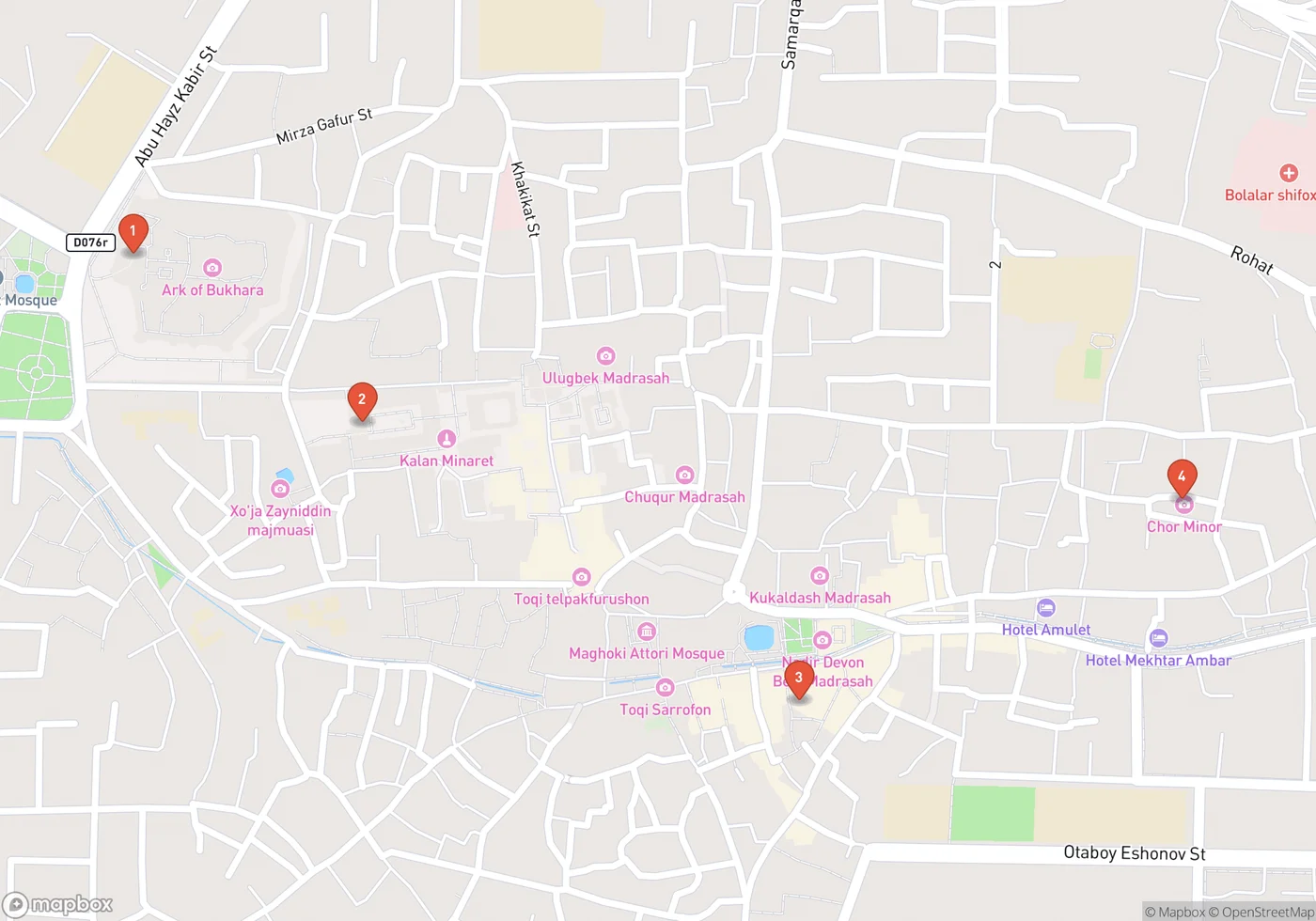
1 Ark of Bukhara, 2 Po-i-Kalyan, 3 Lyab-i-Hauz, 4 Chor Minor. The whole walk is about 1.7 km end to end.
The catch is the arrival. Bukhara's main station is at Kagan, about 13.7 km southeast of the old town — a 25 to 30 minute drive. Budget for it in both directions, and do not cut it fine on the return train.
The Kalyan mosque closes at 6 p.m., earlier than most of Samarkand, so front-load it. The Ark runs to 9 p.m. and Chor Minor to 8. Which means the good evening move in Bukhara is the reverse of Samarkand's: mosque and madrasa interiors in the afternoon, then the lanes and the tea by the pool once the light goes long and the brick turns the colour of dark honey.
Two nights here, not one. Bukhara rewards the second morning — the one where you have no list left and you just walk the residential lanes east of Chor Minor before breakfast.
What the cold front actually means
Right now the medium-range picture for the first half of October runs like this: a genuinely hot spell around the 3rd and 4th — mid-30s in Bukhara, low 30s in Samarkand — then a sharp break. By the 5th and 6th, Samarkand is forecast around 20°C and Tashkent closer to 17°C with rain, and overnight lows across all three cities drop to somewhere between 8 and 11°C. After that it settles into the low-to-mid 20s by day: near-perfect walking weather for the rest of the fortnight.
Treat that as a forecast, not a promise — two weeks out, the timing of a front can slide by a day or two in either direction. But the shape of it is normal for the season, and it's what to pack for:
A light layer you can carry all day, because the 6.30 a.m. start at Shah-i-Zinda and the 2 p.m. stop in the Registan are different seasons.
Something with sleeves for mosque interiors, which is both respectful and, once the front arrives, genuinely warmer than the courtyard.
One waterproof shell. There isn't much rain in this climate, but the day the front lands is the day it falls, and Tashkent's forecast for the 5th has more precipitation in it than the previous week combined.
Shoes you can do 8 km a day in. That is roughly what Samarkand costs you on foot.
Rain, if you get it, is not a lost day. It is the day for the Tashkent end of the trip — Chorsu Bazaar under its great domed roof, open from 8 a.m., and the Hazrati Imam complex a walk away through the old mahallas. It is also the day when a two-hour train ride with a window and a flask of tea stops feeling like transit and starts feeling like the point.
If you only have five days
Land in Tashkent, sleep, and take a morning train west the next day. Two nights Samarkand, two nights Bukhara, fly home from Tashkent or out of Samarkand's airport, which sits just a few kilometres east of the centre and is a far gentler departure than doubling back. Do not try to add Khiva to that; it is a separate trip on a separate train, and squeezing it in is how a good week turns into a blur of stations.
Book the trains first. Watch the ten-day forecast the week before you fly, and if the front has slipped, just swap which afternoons you spend indoors. Everything else about this route is forgiving.
Continue wandering
One more story for the road
September 30, 2026 · Maya Roam
Enter Petra by the Back Door, Leave Through the Siq
Almost everyone walks into Petra through the Siq at nine in the morning. Start at Little Petra instead, arrive at the Monastery from above, walk down through the city, and meet the Treasury at four — with the trail dist…
Read nextInspired to go?