
Travel story 10 min read
MyTravelBuddy Stories
A Gentle First Day in Paris
A soft, practical first-day Paris walk from Luxembourg Garden to Place Dauphine, Palais-Royal, Galerie Vivienne, and the Tuileries.
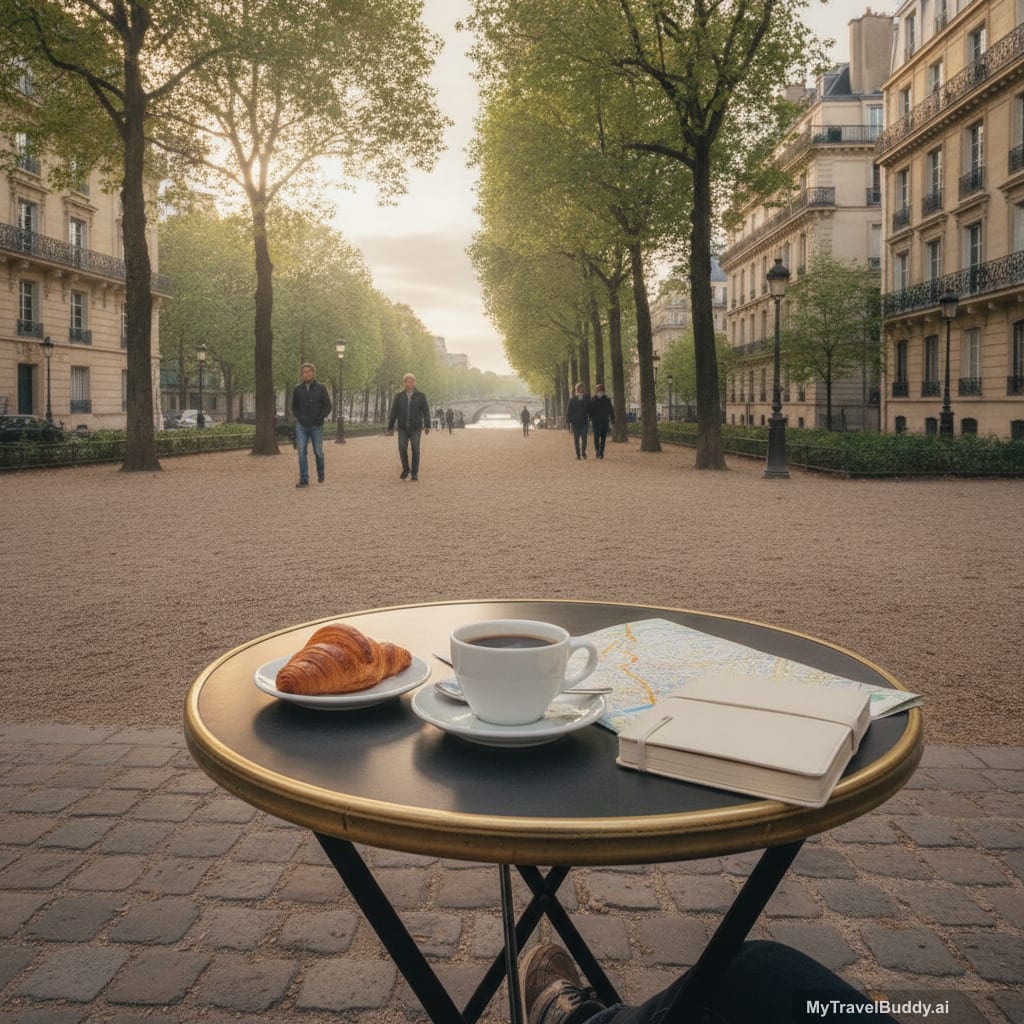
Paris can be surprisingly easy to over-handle.
There are the monuments everyone expects, the reservations everyone says you need, the museums that deserve more than the tired hour you were going to give them, the pastry names that suddenly feel like a language exam, and the quiet worry that you are somehow doing Paris wrong if you are not moved every fifteen minutes.
So I like a first full day that is smaller than the city.
Not because Paris should be reduced. Because it should be entered at human speed.
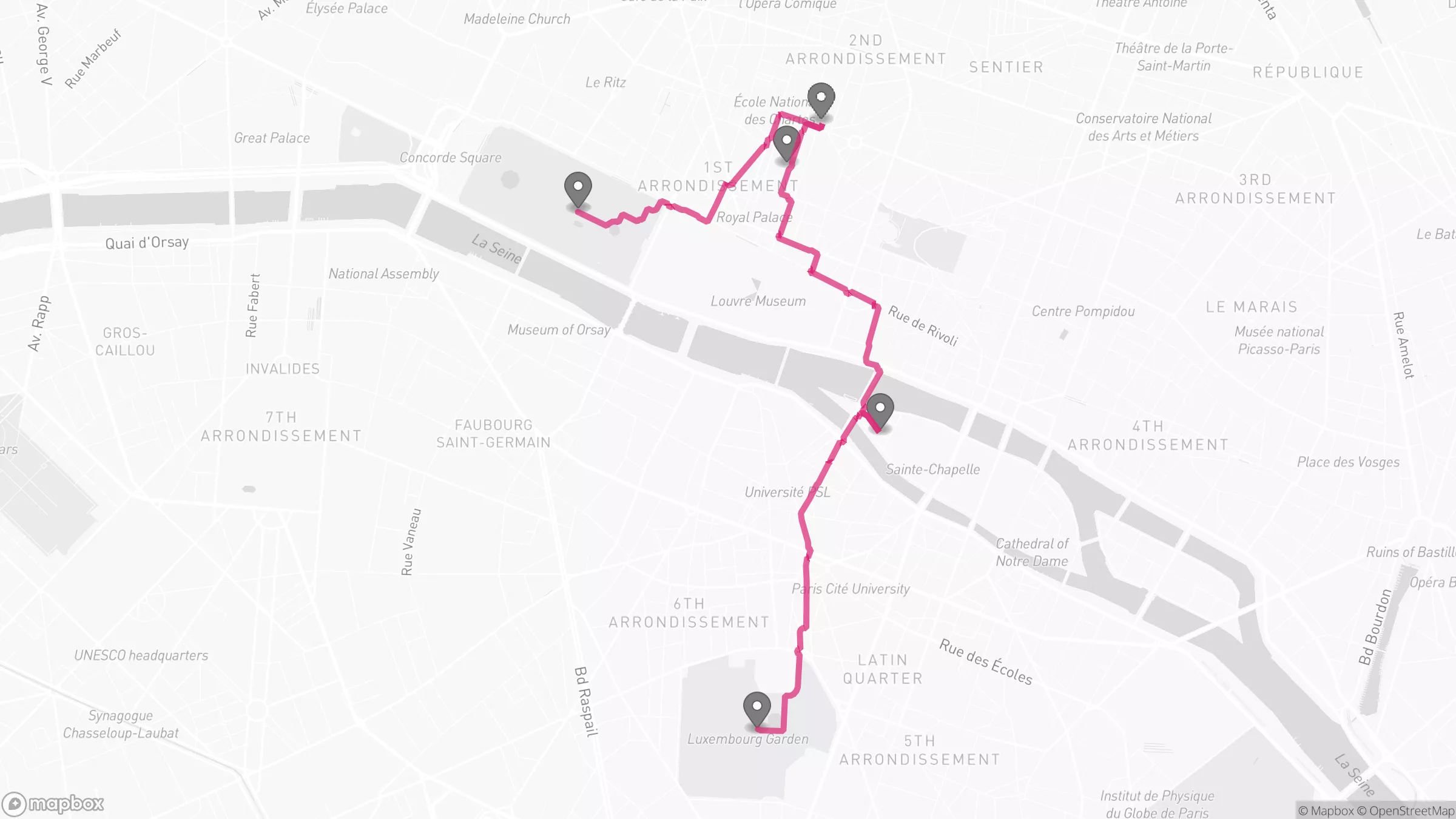
This version begins in the Luxembourg Garden, crosses toward the Seine through Place Dauphine, drifts north into the Palais-Royal and Galerie Vivienne, and finishes in the Tuileries with enough room left for dinner, a museum, or the blessed decision to do very little. It is a walk of about 2.7 miles, roughly an hour before stops, but the point is not the distance. The point is the sequence: garden, island, arcade, garden again.
It gives the day a shape without turning Paris into a checklist.
Start Where Paris Lets You Sit Down
Begin at the Jardin du Luxembourg before the day has fully decided what kind of mood it is in.
Google Places currently lists the Luxembourg Garden as a 17th-century park with formal gardens, patterned trees, and statues on pedestals, which is accurate in the literal way. But the reason to start here is softer than a description. The garden gives you chairs before it gives you instructions. It lets you enter Paris by sitting, watching, and slowly becoming less useful to your phone.
Find one of the green metal chairs near the central basin, or walk under the trees until the city begins to sort itself into sounds: gravel under shoes, pigeons moving with confidence, children negotiating boats, the clipped rhythm of runners, someone reading as if the whole morning had been placed there for that purpose.
This is a good place to let a travel companion do the quiet work in the background. Save the route, check the forecast, hold the map, remember the stops. You do not need to keep reopening five tabs while your coffee gets cold. Paris is better when your attention can stay outside your pocket for a while.
If the current forecast is anything like the one I checked, the next few days are mild and dry, with cool mornings and warmer afternoons. That makes this a layers day: light jacket early, sunglasses later, and no heroic commitment to walking through the hottest part without a pause.
Leave the garden before you have exhausted it. That is one of the better Paris rules.
Cross Toward the Island, Not the Obvious View
From the Luxembourg Garden, the route north toward Place Dauphine takes about twenty minutes if you are walking directly. You will almost certainly not walk directly. Paris has a way of placing bakeries, bookshops, iron balconies, and side streets exactly where your efficient self had planned to be strong.
Let that happen, but keep the island as your next anchor.
Place Dauphine sits on the western end of the Ile de la Cite, close to Pont Neuf. It is quieter than its location should allow. The square has a tucked-away quality, as if the city forgot to turn the volume up here. There are benches, trees, pale facades, and a sense that you have stepped behind the famous Paris rather than away from it.
This is not the place to rush through on the way to the next headline. Sit for ten minutes. Notice how close the Seine is without making the river perform. Notice the triangle of the square, the way the buildings hold the space, the way locals and visitors both seem to lower their voices without being told.
If you want the big cathedral moment, Notre-Dame is nearby. If you want the stained glass miracle, Sainte-Chapelle is nearby too. Both can be worthwhile, and both can also take over the day if you let them. For a first gentle Paris day, I would treat them as options, not obligations. The story of this walk is not maximum beauty per hour. It is the practice of choosing enough.
Cross Pont Neuf slowly. The name means "new bridge," although it is the oldest standing bridge across the Seine in Paris. That little Paris joke is useful: the city is always making you hold two truths at once.
Old and new. Famous and private. Grand and daily.
Let the Palais-Royal Reframe the Afternoon
The walk from Place Dauphine toward the Palais-Royal is the longest leg of this route, about eighteen minutes before pauses. It carries you away from the island and back into the right bank, where Paris starts changing texture again.
The Jardin du Palais-Royal is currently listed as a 17th-century palace garden with tree-lined walkways, flowerbeds, and a large fountain. It is formal, yes, but not stiff. The pleasure here is in the proportions: arcades, gravel, trees, benches, water, and the feeling of being slightly removed from traffic without being sealed away from the city.
This is where I would make the day honest.
If you are tired, sit. If you are hungry, eat nearby instead of pretending you can run on atmosphere. If you want a museum, the Louvre is close enough to tempt you, but close does not mean wise. The Louvre is not a casual errand. It is a whole decision. Unless you planned for it, let its presence be part of the neighborhood rather than the center of the day.
The Palais-Royal is a better first-day pause because it teaches a useful Paris skill: you do not have to enter every famous room to be changed by the city around it. Sometimes the threshold is enough. Sometimes the garden outside the palace is the better choice because it leaves the rest of the day intact.
This is also a good point to check the weather again. A mild dry forecast makes wandering easy, but Paris still changes with cloud cover, wind, and fatigue. If the afternoon is warmer than expected, slow down here before the next short leg.
Step Into Galerie Vivienne
Galerie Vivienne is only a few minutes from the Palais-Royal, but it feels like a change of weather.
The covered passage was built in 1823, according to the Google Places summary, and today it holds shops, restaurants, and the kind of mosaic floors that make people suddenly interested in looking down. It is elegant in a way that could become precious if it tried harder. Fortunately, the passage still has a practical rhythm: people browsing, eating, ducking in from weather, using beauty as a shortcut.
This is one of the reasons I like it for a first day. It offers Paris indoors without asking for a museum ticket. If rain appears, it becomes shelter. If the sun is bright, it becomes contrast. If your feet are beginning to understand that cobblestones are not decorative for the body, it becomes a soft reset.
Look at the floor. Look up at the glass roof. Step into a bookshop if one is open. Consider coffee or something small to eat, but do not turn the passage into a shopping mission unless that is truly what you want. The better use of Galerie Vivienne is to let it shift the scale of the day. You have moved from broad garden to river island to palace courtyard to a covered urban interior. Paris is not one mood. It is a series of rooms, some of them outdoors.
If you are traveling with someone, this is a good place to separate for ten minutes and then meet again. One person looks at windows. One person takes photographs. One person reads a menu with too much seriousness. Then the day comes back together.
Small separations make travel companionable.
Finish in the Tuileries Without Needing a Finale
From Galerie Vivienne, the final walk to the Tuileries Garden is under a mile. The route bends past some of the city's most familiar gravity: the Louvre, the Rue de Rivoli, the long axis toward the Place de la Concorde. It would be easy to make this feel like a march toward significance.
Do not.
Let the Tuileries be what it is: an expansive 17th-century formal garden, broad and open, with statues, chairs, gravel paths, and enough sky to let the day exhale. The Tuileries can be crowded, but it is also generous. There is usually some chair, some angle, some patch of late light that belongs to anyone willing to stop moving.
This is a good place to decide what kind of evening you actually have.
If your energy is high, you can continue toward the Musee d'Orsay, return to the Louvre for a planned evening visit, or cross the Seine for dinner. If your energy is low, that is not failure. Paris is not improved by dragging yourself through it resentfully. Buy water. Sit. Watch the city pass through its own garden.
The best first day in Paris may not be the day when you see the most. It may be the day when the city becomes possible.
A Practical Shape for the Day
Start in the Luxembourg Garden after breakfast or with coffee nearby. Give yourself enough time to sit before walking north.
Walk toward Place Dauphine and Pont Neuf, allowing detours but keeping the island as your anchor. Treat Notre-Dame and Sainte-Chapelle as optional additions only if you have time, tickets, and real interest.
Continue toward the Palais-Royal for a longer pause. This is the best place to adjust the day based on weather, appetite, and energy.
Step into Galerie Vivienne for a covered-passage chapter: architecture, shops, mosaic floors, and a reset from the street.
Finish in the Tuileries. Decide there whether the evening wants a museum, dinner, a river crossing, or nothing more ambitious than sitting in a chair with Paris happening around you.
The route I checked is about 2.7 miles and roughly one hour of walking before stops. In real life, with coffee, photographs, benches, crossings, indecision, and the usual Paris interruptions, it is half a day or more. That is the point.
What to Skip, At Least Today
Skip the idea that your first day has to prove anything.
Skip the overstuffed itinerary that tries to include the Eiffel Tower, the Louvre, Montmartre, Notre-Dame, shopping, a river cruise, and three perfect meals before you have learned how the sidewalks feel under your shoes.
Skip restaurants that require you to cross the city when you are already tired. Save the heroic dinner plan for a day that has not been built on walking.
Skip the guilt of not going inside everything. Paris is full of interiors worth entering, but a first day can be built around thresholds: garden gates, bridge views, passage roofs, palace arcades, the chairs that wait in public gardens as if the city has been expecting you.
Most of all, skip the version of Paris that exists only to be collected.
This city has endured too much attention to be impressed by yours. The kinder thing is to arrive with curiosity, some humility, and a little room in the day.
That is enough for a beginning.
Research Notes
Place names, coordinates, and summaries were checked with Google Places for Jardin du Luxembourg, Place Dauphine, Jardin du Palais-Royal, Galerie Vivienne, and Tuileries Garden. Google Routes calculated the walking route at about 2.7 miles and roughly 60 minutes before stops. Open-Meteo showed a dry, mild near-term Paris forecast at publication time, with cool mornings and warmer afternoons; check the current forecast before building a real travel day around it.
Continue wandering
One more story for the road
September 26, 2026 · Maya Roam
On the Albanian Riviera, the Sea Is Still Warmer Than the Air
The Ionian is holding about 25.6°C while the air tops out near 23°C, the loungers are coming off the sand, and the coast road is finally empty. Himarë to Sarandë is only 55.7 km — and still takes ninety minutes, which i…
Read nextInspired to go?