
Travel story 11 min read
MyTravelBuddy Stories
Bologna Has 62 Kilometres of Roof
Bologna has roughly 62 kilometres of covered portico, about 38 of them inside the historic centre, and the result is a city you can cross — and climb 200 metres of hill in — without ever stepping into the weather. The s…
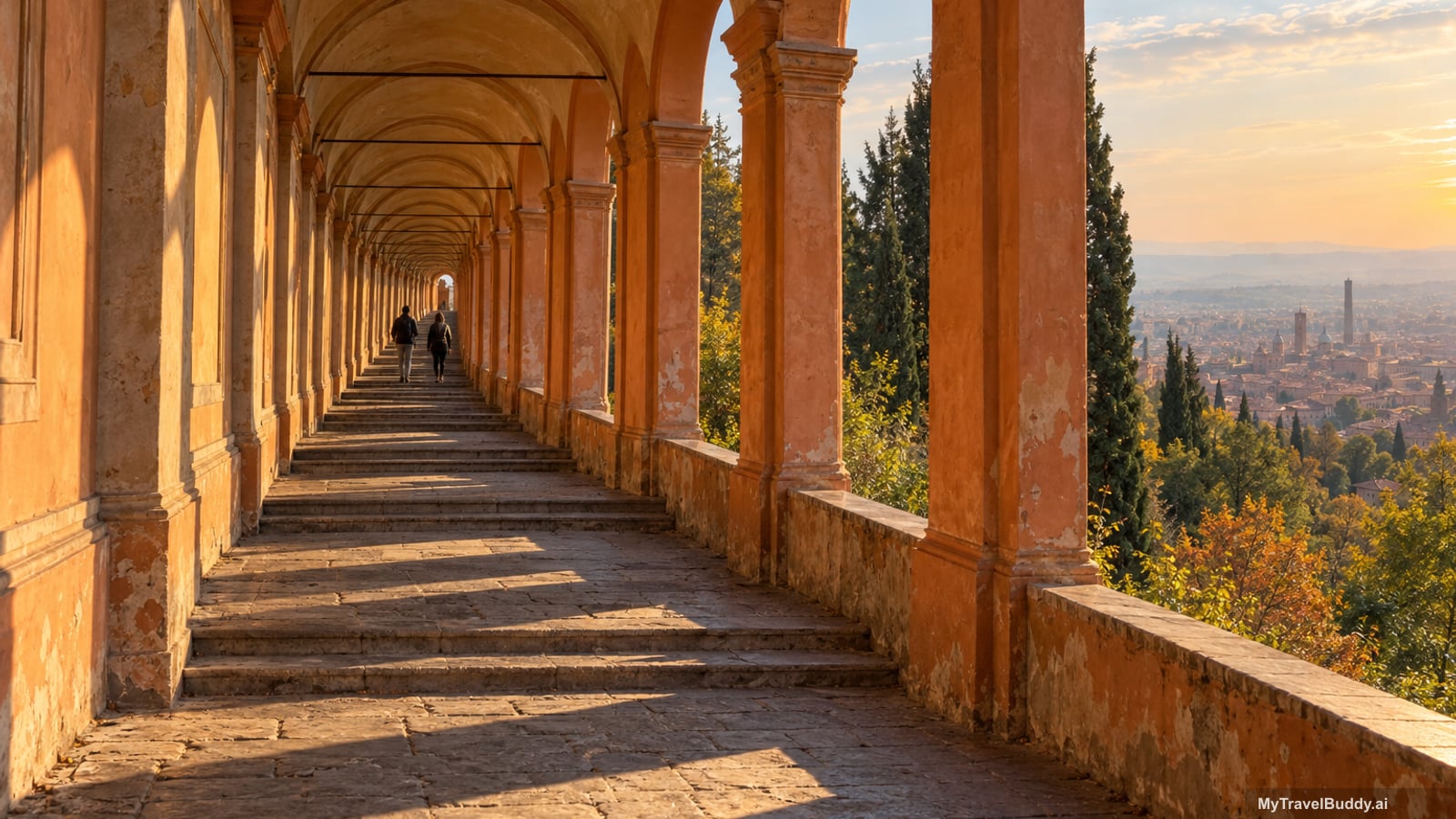
Most cities give you a choice in October. You can have the long walk or you can have the weather, and some mornings you don't get to pick which one you're having.
Bologna quietly opted out of that bargain about nine hundred years ago. The city has roughly 62 kilometres of portico — covered, colonnaded walkway running along the front of its buildings — and about 38 of those kilometres are inside the historic centre alone. Landlords started building them in the Middle Ages to bolt extra rooms onto upper floors, the city eventually made them compulsory, and the accidental result is a town you can cross end to end, and 200 metres up a hill, under a roof the whole way. UNESCO put twelve stretches of it on the World Heritage list in 2021.
It is the most useful piece of architecture I know, and almost nobody comes to Bologna for it.
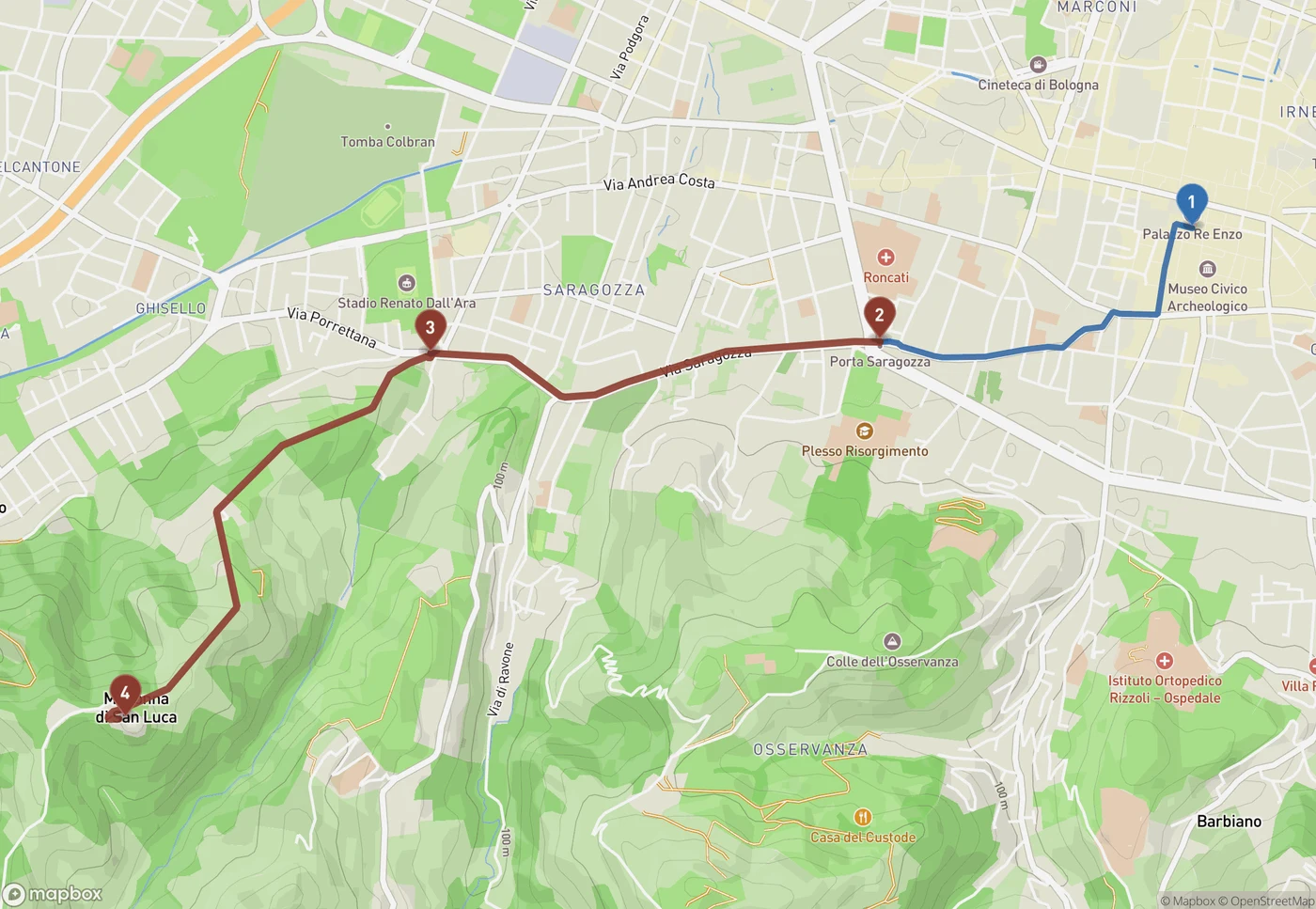
Three acts: Piazza Maggiore (1) to Porta Saragozza (2) is flat city walking, Porta Saragozza to the Arco del Meloncello (3) runs out through the suburbs, and the Meloncello to the sanctuary (4) is the 1.9 km that climbs. The whole thing is covered.
The walk that explains the city
Start with the showpiece, because it is also the clearest argument. The Portico di San Luca is the longest covered walkway in the world: 3.8 kilometres of continuous arcade running from the edge of the old city up to a sanctuary on a wooded hill. The arches are famously numbered 666 in every guidebook and on every fridge magnet; the city's own restoration paperwork counts 658. Nobody in Bologna seems remotely troubled by this.
The honest route from the middle of town goes in three acts, and they feel completely different from one another:
- Piazza Maggiore to Porta Saragozza — about 1.4 km, twenty minutes, dead flat, and already under cover for most of it. This is the city gate where the portico proper begins.
- Porta Saragozza to the Arco del Meloncello — about 1.6 km, twenty-odd minutes, still basically level, running out through a residential stretch that tourists mostly skip. The Meloncello is a baroque arch that vaults the portico over a road junction, and it is where the walk changes character.
- Meloncello to the sanctuary — about 1.9 km and a solid 37 minutes, because this is the part that climbs.
Piazza Maggiore sits at 74 metres. The sanctuary sits at 276. So the last stretch is a genuine 200-metre ascent on steps and ramps, and the mapping apps will tell you the whole thing is 4.8 km and 79 minutes. Budget closer to an hour and three quarters with the climb, the stops, and the entirely reasonable urge to sit down on the low wall and look at the view. Coming down takes well under an hour and is much easier on the lungs and much harder on the knees.
What makes it strange and lovely is that all of it is covered. You climb a hill in full sun or in a downpour and you are, the entire time, indoors-ish — in a long perspective of ochre arches with the Emilian plain opening up through the columns on your right.
The scaffolding is finally gone
If you looked at this walk in recent years, you looked at it through builders' netting, and that is worth knowing because it has changed.
The hillside stretch — Meloncello up to the sanctuary, which is exactly the 1.9 km you most want to walk — has just come out of a major restoration: about 1,800 linear metres and 341 of the arches, funded at €6.85 million by the Emilia-Romagna region and the Ministry of Culture. The works repaired damage left by the 2012 earthquake and added seismic strengthening, rebuilt the plaster and the roofing along the whole run, and cleaned the painted lunettes of the Mysteries set into the vaults above your head. Those lunettes are the detail most people walk straight under without looking up. Look up.
The city has also said it will ask UNESCO to redraw the San Luca boundary to take in part of neighbouring Casalecchio di Reno, and to fold the Garisenda tower into the site — which brings us to the awkward thing.
About the tower you were going to climb
Bologna's postcard image is the two leaning towers, and the tall one, the Asinelli, is the view everyone books. It has been shut to climbers since engineers got worried about movement in the leaning Garisenda next door, and the square around both towers has been fenced into a construction site while the Garisenda is stabilised. As of now there is no public reopening date, and third-party listings — including Google — still cheerfully show opening hours for the ticket office. Check the official city booking site before you build an afternoon around it, and assume the answer is no.
Which, conveniently, is the best argument for the portico I can give you. The city's high view is now at the top of that hill, and you get to it on foot, for free, in the shade.
If 200 metres of climbing isn't in the plan, San Michele in Bosco is the shortcut: about 2 km and half an hour from Piazza Maggiore, a much gentler rise, and a terrace that looks straight down the spine of the city. It's the view locals actually use on a weekday evening.
And if you'd rather not walk up San Luca at all, you don't have to. A tourist road train runs up from the centre through the season and saves you the ascent entirely — a fair trade if you're travelling with someone who'd enjoy the sanctuary but not the staircase. City buses run out along Via Saragozza toward the foot of the hill too; Villa Spada, a public park with a good lawn, is about 1.4 km past Porta Saragozza and makes a decent bail-out point. The sanctuary itself keeps long hours, roughly 7am to 7pm daily, so a late-afternoon climb into golden light is entirely doable — just don't start one in the dark.
The covered centre is the other half
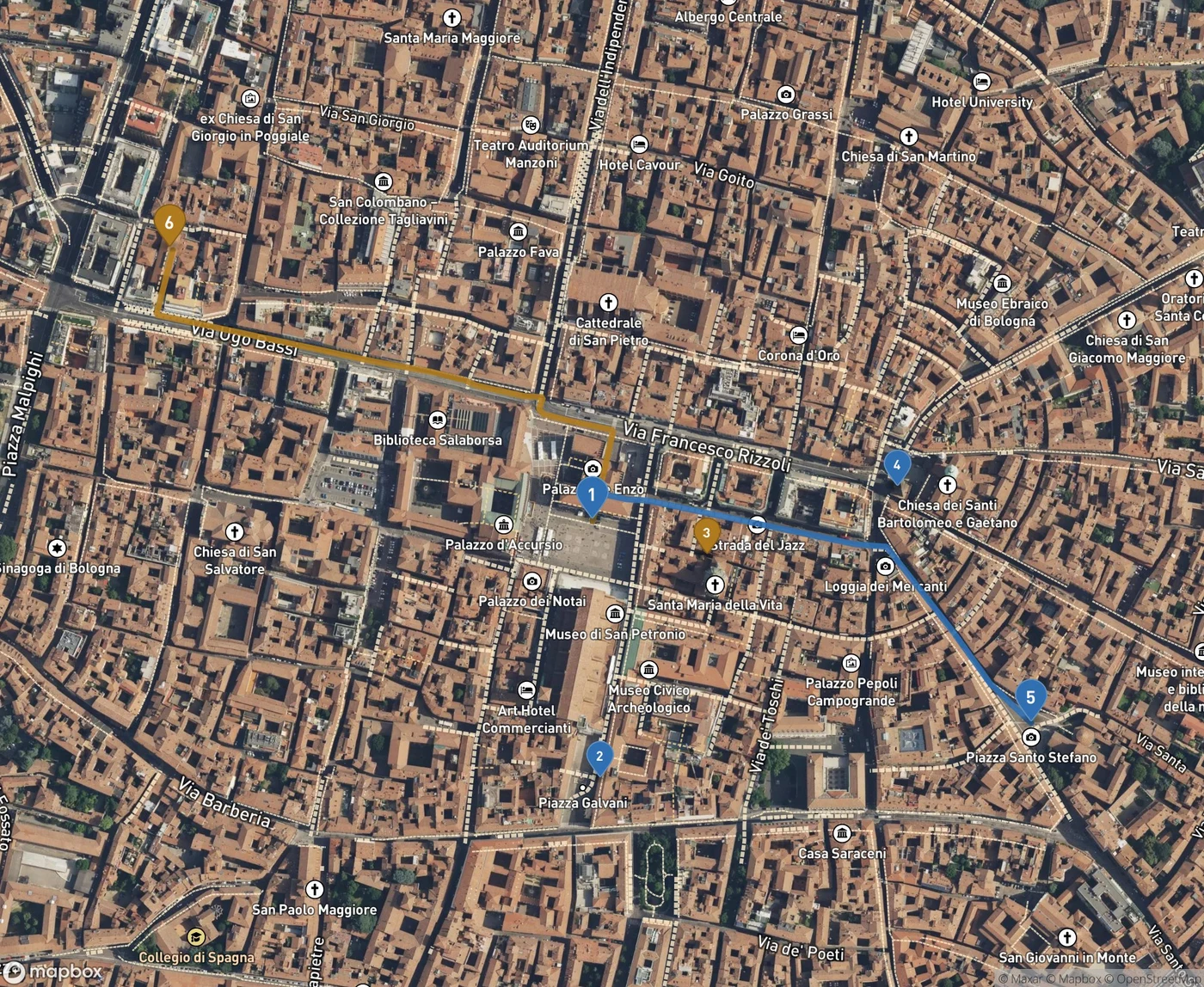
Everything in the covered centre is closer than you expect: Piazza Maggiore (1) to the Due Torri (4) is 350 metres, to Piazza Santo Stefano (5) seven minutes, to the Mercato delle Erbe (6) about 600 metres.
The San Luca walk is the famous portico. The everyday one is better.
Bologna Centrale to Piazza Maggiore is 1.6 km, about 23 minutes, and you can do nearly all of it under arcade — which is why I'd always rather arrive here by train than fly in. Once you're in the centre, the distances collapse. Piazza Maggiore to the Due Torri is 350 metres. To Piazza Santo Stefano, 500 metres and seven minutes. To the Mercato delle Erbe, 600 metres.
A few covered things worth aiming at:
- The Portico del Pavaglione, along the side of Piazza Maggiore, is the grandest stretch in the city and the one you'll walk a dozen times without meaning to. The Archiginnasio opens off it — the old university building, with a wooden anatomical theatre upstairs and walls carpeted in the coats of arms of centuries of students. It's open weekdays until 7pm and Saturdays only to 2pm, closed Sundays, which catches people out.
- The Quadrilateral, the knot of lanes around Via Pescherie Vecchie just east of the square, is the old market district and still a working one: fishmongers, cheese counters, a greengrocer stacking artichokes at eye height. It's at its best mid-morning and turns into a loud outdoor aperitivo after six.
- Mercato di Mezzo, in the middle of that, is the indoor food hall version — open late, more polished, useful when you want everyone fed without a reservation.
- Mercato delle Erbe is the one I'd send you to instead: a proper neighbourhood market with stalls and small kitchens along the sides. Open 7am to 7:30pm, closed Sundays.
- Piazza Santo Stefano is the prettiest square in Bologna and the only one that feels private, with its complex of linked medieval churches on the end. Note the long lunch closure — roughly 12:30 to 2:30 — which eats the middle of a lot of afternoons.
- Osteria del Sole, tucked in a Quadrilateral alley, sells wine and only wine; you bring your own food, buy it from the stalls outside, and sit at a shared table. It's been doing this since the fifteenth century and it is not a tourist gimmick.
What October actually feels like right now
Here is the part that changes what goes in your bag. I pulled the sixteen-day forecast for Bologna on 8 October, covering 8–23 October, and it does something quite dramatic.
| 8 Oct | 23 Oct | |
|---|---|---|
| Daytime high | 25.6 °C | 16.6 °C |
| Overnight low | 17.3 °C | 8.7 °C |
The highs slide about nine degrees across the fortnight, and the overnight lows fall harder — down to 5.5 °C on the coldest forecast night, around the 20th. That is the difference between a t-shirt trip and a proper-jacket trip, inside two weeks, in the same city.
The rain is the surprise. The same forecast gives Bologna roughly 9 mm of rain across the whole sixteen days, concentrated in two or three wet spells, with only about fifteen hours in 384 registering meaningful precipitation. So the irony is complete: I am recommending a city built to keep the weather off you during a fortnight that is forecast to be almost entirely dry. Forecasts this far out are a shape rather than a promise, and the back half will have moved by the time you read it. But the shape is useful — right now the porticoes are doing shade duty rather than umbrella duty, and by the end of the month they'll be doing windbreak.
Up at the sanctuary, knock a degree or two off everything; at 276 metres it runs consistently cooler than the centre, and the nights up there are forecast as low as 4.5 °C. Layers, and shoes with grip — the portico's worn stone paving gets genuinely slick when it's wet.
Bologna is also the best-connected base in Italy
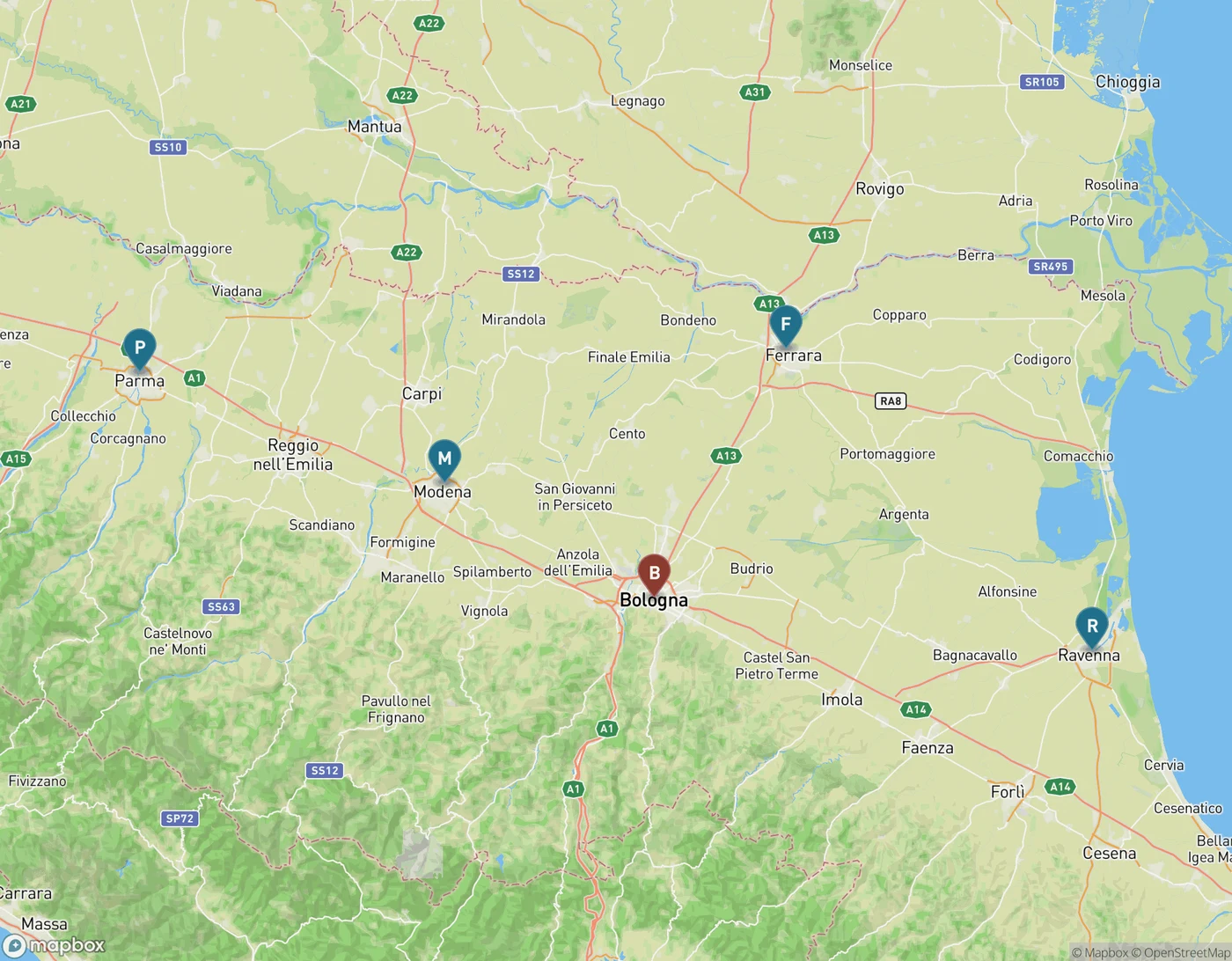
Direct trains from Bologna Centrale: Modena about 28 minutes, Ferrara about 46, Parma about 64, Ravenna about 84. Four cities inside an hour and a half of one hotel.
The thing that makes Bologna undervalued as a stay — rather than a day stop on the way to Florence — is the station. Direct trains put an unreasonable number of good cities inside an hour:
- Modena — about 28 minutes. Balsamic, the Ghirlandina tower, and a cathedral that is a better building than it has any right to be.
- Ferrara — about 46 minutes. Flat, walled, built for bicycles, and strangely empty of tourists.
- Parma — about 64 minutes. Ham, parmesan, and the Correggio frescoes.
- Ravenna — about 84 minutes, and the one I'd insist on. The sixth-century mosaics there are, genuinely, among the most beautiful things in Europe.
Four nights in Bologna with two day trips is a better week than four nights split between two hotels, and it costs less. If you're still arranging the pieces, this is exactly the kind of trip where the base matters more than the itinerary — pick the hub, then decide each morning based on how your legs feel.
The short version
Come for four nights, stay in the centre, and walk everywhere. Do the San Luca portico on a clear morning while your legs are fresh — three kilometres flat, then two kilometres up, all of it covered, with the restoration finally finished and the netting gone. Don't plan on the Asinelli tower. Save Sunday for things that are open on Sunday. And pack for two seasons, because this fortnight is handing out both.
Bologna is not trying to impress you. It is just the only city I know that built itself a roof and then got on with lunch.
Continue wandering
One more story for the road
October 7, 2026 · Maya Roam
Sri Lanka's Hill Country Is Dry Until Noon
October puts Sri Lanka in the second inter-monsoon, and the forecast says something most itineraries get backwards: the famous hill country around Kandy, Nuwara Eliya and Ella is the wettest band on the island right now…
Read nextInspired to go?